Why Having Accounting Software is a Must for Manufacturing Companies in the UAE?
Sophia
Senior content writer
Mon Dec 01 2025
Get in touch with us
Manufacturing in the UAE contributes more than 11% to the national GDP, and in Abu Dhabi alone, industrial output exceeded AED111.6 billion in 2024. Basically, the sector is expanding fast, powered by export incentives, economic diversification policies, rising infrastructure projects, and high demand in metals, plastics, food processing, and industrial machinery.
But most outsiders often ignore one part. Manufacturing isn’t just production lines and raw material. Rather, it’s a multi-layered financial complexity. Here, you need to track all at once, including shipment-based tax rules, local and international compliance, fluctuating raw material costs, inventory valuation, factory overhead, batch-wise production costing, supply chain finance, and more. So, a single error can ripple across your procurement, production, warehousing, sales, and audit trails.
At the same time, the UAE follows IFRS standards for financial reporting. The nation applies VAT at 5% with strict audit documentation and has rising compliance requirements under FTA digital tax filing and e-invoicing expectations.
Relying on some disjointed tools in this scenario will obviously lead to extreme struggle to maintain financial accuracy, cost visibility, and regulatory alignment.
But worry no more. You can survive all of these with an industry-built accounting software in UAE, as a bonus, but as the base of financial control. The right system brings production cost clarity, inventory precision, VAT-proof documentation, automated financial consolidation, error-free audit readiness, and instant financial intelligence in your workplace without slowing operations down.
The Problem with Manufacturing Accounting
Financial management in manufacturing has a very different footprint compared to retail or services.
You need to know:
The exact cost of raw materials before and after import duties.
The inventory value at every production stage.
The exact cost allocation of electricity, labor, storage, depreciation, equipment maintenance, and factory rent.
The financial impact of every waste, rework, or returned shipment.
Multi-currency bookkeeping is required if you are dealing with international suppliers.
Batch tracking for regulated industries like food, pharma, and chemicals.
Accurate reports for investors, auditors, and government entities.
It definitely sounds manageable when listed out. But when these activities run simultaneously across multiple departments, that becomes a different story.
Automate Cost & Inventory Control
Manual tracking leads to errors. Switch to accounting software to monitor raw materials, production costs, and wastage in real time.
Here, most of the manufacturing firms hit the same barriers:
Manual costing is inaccurate: Without automated production costing, companies often struggle to calculate the real per-unit cost, especially in batch production.
Inventory counts don’t match financial books: Stock moves between raw goods, WIP (Work-in-Progress), finished goods, and dispatch. If the finance system isn’t tied to production, reconciliation can become a monthly headache for you.
VAT documentation isn’t export-ready: The FTA doesn’t just require VAT payment. It requires supporting evidence, invoice trails, stock proof, export documents, delivery notes, and correct VAT classification.
Disconnected data: Suppose the procurement uses one tool, and the sales team uses another. Similarly, production cost sheets are somewhere else, and the finance team pulls numbers from everywhere, hoping they can align. Well, when the UAE market moves at this speed, this “hoping” can never be a strategy.
The UAE-Specific Factors That Make Accounting Software Even More Critical
Government Push Toward Digital Financial Traceability
The UAE is aggressively adopting digital tax governance.
Local sales apply the 5% VAT rule with auditing evidence.
If you handle all three, this means your accounting tool must handle multi-jurisdiction VAT logic at the transaction level, not at the reporting level.
Complex Supply Chain & Production Cost Increments
Raw material landed cost isn’t just the purchase price. It includes freight, customs, clearance, insurance, transportation, storage, wastage, and handling.
A reliable accounting system calculates landed cost, pushes it into inventory valuation, and rolls it into production cost without breaking reconciliation.
Scalability Demands in a High-Growth Market
The UAE manufacturing sector includes businesses that grow from local distribution to GCC supply chains in 12–18 months.
Your finance tool needs to grow from one warehouse to multiple, one currency to many, basic accounting to production-linked finance.
Why Manufacturers Are Moving to Accounting Systems Built for Their Industry
Accounting platforms for manufacturing companies do more than generate invoices or balance sheets. They solve operational finance problems.
1. Production Costing Without Guesswork
Manufacturing finance teams need job costing, bill of materials (BOM) costing, process costing, overhead allocation, and WIP valuation.
Modern Accounting Software in Dubai can compute all the production costs by pulling data from materials issued, labor assigned per job, machine hours consumed, overhead percentage, and waste recorded. This means your cost per unit is precise and there are no assumptions.
And you know what? When you finally see actual production cost vs expected cost, it changes the ability of decision-making entirely. You can spot where the margins are leaking, including material price spikes, production delays, resource overuse, or excessive waste.
2. Inventory Valuation That Actually Reflects Reality
In manufacturing, inventory isn’t static. It transitions in phases. The UAE allows multiple valuation methods, like FIFO (First-In, First-Out). Also, weighted average costs are commonly used under IFRS. But applying them manually across dynamic moving stock is completely risky.
The best accounting software updates inventory value as stock is consumed and produced. It also converts raw material cost into WIP automatically. WIP cost reclassifies into finished goods without manual journal entries.
3. VAT Compliance: the FTA Can’t Question
FTA audits for manufacturing companies dive deep into transactional proof, and the requirements are rigid.
Manufacturers need documented evidence for:
Local taxable sales
Reverse charge mechanism for imports
Export sales under zero-rated VAT
Customs declarations
Transportation and delivery proof
Invoice audit trail
Inventory movement support
VAT ready accounting software classifies VAT at the source. They maintain invoice trails, link documents, store transaction logs, track export VAT codes correctly, and eliminate misfiling risk. Honestly, when your VAT filing stops becoming challenged, the peace that comes after that becomes unmatched.
Stay Fully VAT & Compliance Ready
Avoid fines and incorrect filings. Get accurate VAT calculations and automated financial reports tailored for UAE regulations.
4. Multi-Currency and Supplier Payments Without Chaos
Most UAE manufacturers import materials from China, India, Europe, and the US. That means they are often dealing in AED, USD, CNY, INR, or EUR simultaneously.
Automated AI-based accounting software records foreign exchange gain & loss, updates payable values on rate changes, and maintains compliant international ledgers. Payments to suppliers map directly into accounting and inventory impact.
5. Factory Overhead Allocation That Finally Makes Sense
Manufacturing overhead is often the largest unoptimized cost segment.
The UAE manufacturing landscape includes:
Industrial rent or factory lease.
Machinery depreciation.
Utility bills.
Labor cost by production job.
Equipment maintenance.
Storage and warehouse cost.
Vehicle fleet expenses.
Insurance and compliance fees.
Smart accounting platforms allocate these costs based on production volume, job type, department percentages, or machine hours consumed.
Which means you're not just seeing revenue vs expenses. You're seeing which job or production line absorbed what cost.
6. Audit-Ready Reports That Match UAE Regulations
When your financial reports follow IFRS and maintain VAT-compliant proof, auditors get exactly what they expect.
Manufacturers can generate using the software:
Financial statements
Costing reports
Inventory valuation
Payable aging
Production cost sheets
VAT returns with document linkage
Export VAT classification reports
Cash flow statements
And do you know what the best part is? These reports align across procurement, production, sales, and finance automatically.
7. Instant Financial Intelligence
UAE manufacturers are moving away from “what happened last month” reporting. They want immediate insights.
An integrated accounting system provides dashboards, variance analysis, real-time costing insights, cash flow visibility, purchase impact forecast, and inventory value at any stage. That means decisions don’t wait for the month-end. They happen in the motion- instantly.
The Features UAE Manufacturers Should Prioritize
Here’s how manufacturers shortlist accounting software:
Costing that includes: BOM, job costing, process costing, WIP valuation, and overhead allocation.
Inventory that includes: “Raw - WIP - Finished stock movement”, FIFO or weighted average valuation, reconciliation reports.
VAT that includes: Export 0% VAT classification, reverse charge application, document linkage, and audit trail.
Payments that include: Multi-currency support, FX gain/loss auto entry, and supplier aging.
Reports that include: IFRS-aligned statements, VAT return with evidence, variance analysis, and stock valuation.
Integrations that include: Procurement - Production - Sales - Finance linkage.
Because anything short of this falls into the same problem zone - disconnected financial truth.
Local Options Manufacturers Rely on in the UAE
The UAE manufacturing sector leans heavily toward:
ERP-powered finance systems like TallyPrime, Odoo ERP, QuickBooks, and customized ERP accounting modules.
Companies often customize these to match factory costing layers and export VAT rules.
Cloud adoption has increased sharply because manufacturers have multiple warehouses & multi-location plants.
If You’re Still Using Sheets for Production Finance, Then Let’s Talk
At some point, every manufacturer has the same realization:
You can’t optimize profit if you can’t see the cost until month-end.
You can’t protect VAT filings if you can’t prove every transaction trail.
You can’t grow without inventory syncing with finance automatically.
You can’t lead in one of the fastest industrial markets with systems stitched together manually.
Isn’t it better to remove the risk than keep working around it?
So, accounting software for manufacturers in the UAE is all about financial ground truth. The market, tax system, currency flow, supply chain model, FTA audits, all of it demands structured, verifiable, production-linked accounting, not surface-level bookkeeping.
In this tight situation, companies adopting the right finance stack aren’t just staying compliant. They’re decoding manufacturing cost layers, protecting margins, scaling without reconciliation chaos, and filing VAT returns that hold up under the toughest scrutiny.
If you're considering a serious upgrade, start with one question:
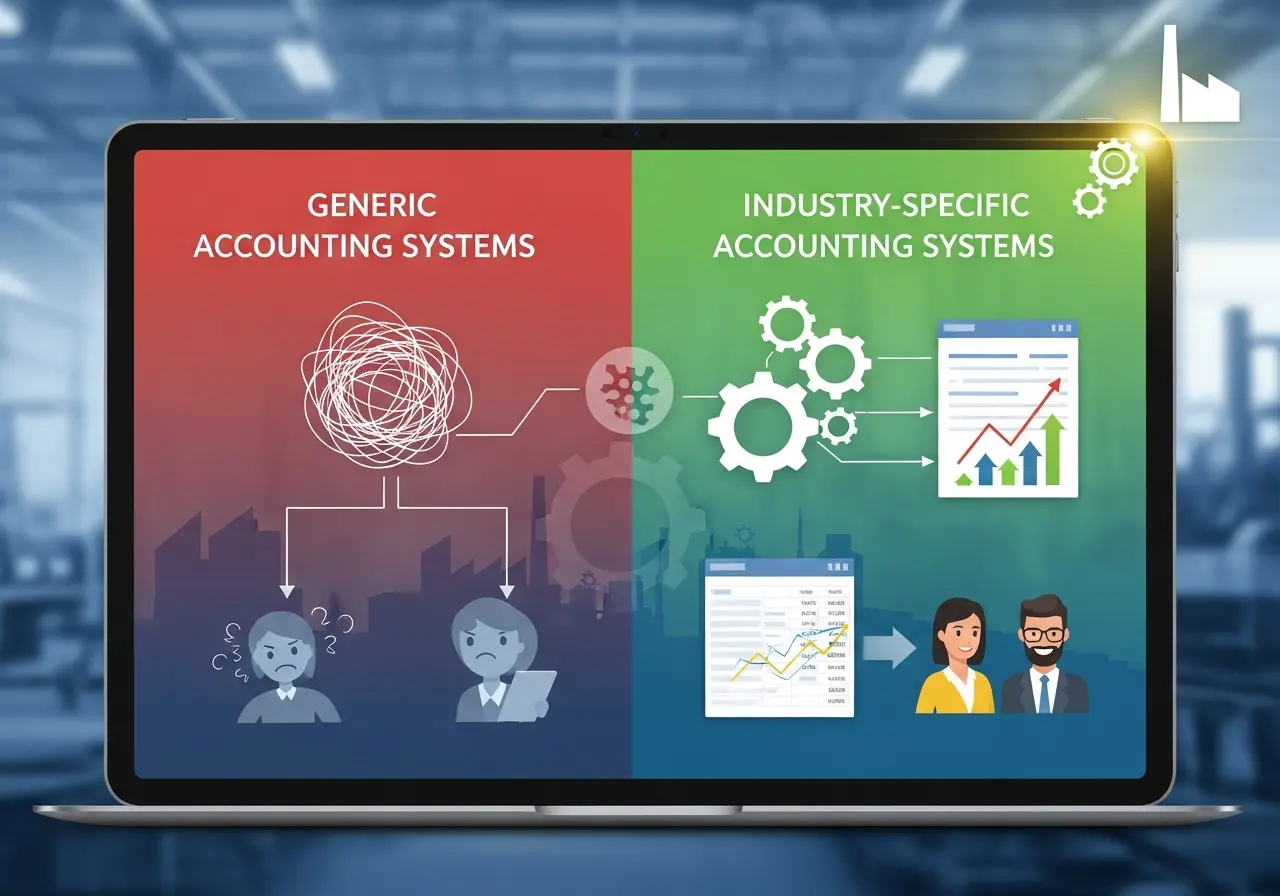
Does this system understand manufacturing finance, or just general accounting?
That answer will change everything.
And if you want help evaluating the right fit for your business, contact us at Penieltech today. Because the conversation isn’t complicated, rather it’s necessary.
Boost Profitability with Real-Time Insights
Track projects, monitor cash flow, and make decisions faster with live dashboards and analytics.
Related Articles
Explore more insights, ideas, and practical knowledge from our latest writings.