Odoo Is Powerful. So, Why Are Businesses Still Struggling With It?
Morgan
Senior content writer
Fri Jan 16 2026
Get in touch with us
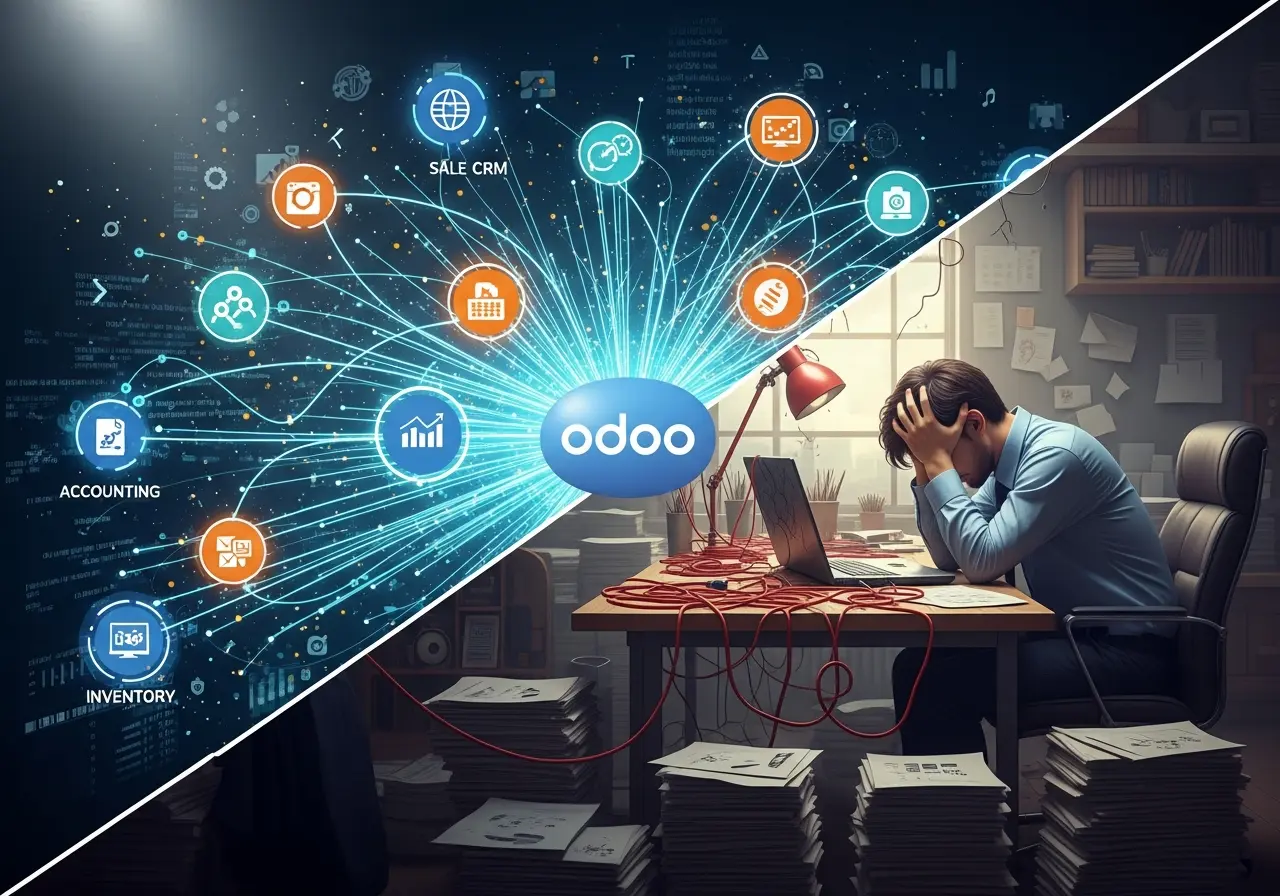
Odoo itself can replace lots of separate systems, yet plenty of UAE businesses still juggle spreadsheets, payment portals, and a patchwork of tools alongside their ERP. That contrast isn’t just ironic; it also reveals where most projects break down. No, not in the core software, but in people, planning, and integration. Odoo has the breadth to run finance, inventory, e-commerce, HR, and more under one platform. Still, the Gulf between potential and everyday reality shows up in missed KPIs, blown budgets, and, most importantly, frustrated teams. Some of these problems are universal for ERP projects, while the others are specific to the UAE’s regulatory, multi-entity, and growing business environment.
Where things go off track
Before we dig into the specifics, here’s the simplest way to look at it - Odoo’s power exposes weaknesses. If the processes aren’t clear, data isn’t clean, or people aren’t onboard, the system can amplify those gaps instead of fixing them. That’s why implementation decides success or failure.
General Challenges in Implementation
Strategic planning & clear goals
Jumping into Odoo without measurable goals is like building something without a blueprint. You are spending on features, and then discovering they don’t move the needle. In the UAE, where companies expand quickly across jurisdictions and business lines, a documented target like what KPIs improve and which processes change is completely non-negotiable.
Data migration & integrations
Data migration
this is where projects silently bleed time and money both. Legacy records often come in inconsistent formats, like invoices and SKU codes don’t match, and historical balances need reconciliation. Then just add integrations with that - banks, POS, shipping, government portals, and each connector will introduce risk. So, always expect extra time for data cleansing, mapping, and testing. Because migration woes are a top reason companies need to delay or abandon ERP rollouts.
Expert Odoo Implementation
Most Odoo issues start with poor implementation. Our certified consultants map your business processes and configure Odoo the right way from day one.
Change management & user adoption
ERP projects never finish after going live. Basically, that's when the real work begins. When users don’t see clear benefits or haven’t been trained for their specific tasks, they automatically fall back to spreadsheets and shadow systems. In the UAE’s multicultural workforce, training must be role-based, frequent, and pragmatic to show people how the system saves time in their daily tasks.
Picking the wrong partner
All the Odoo partners are different. The platform’s flexibility tempts some vendors to customize instead of simplify. While others understaff projects or treat implementation like a one-off delivery rather than an ongoing business relationship. When a partner lacks local compliance experience, such as VAT filings, payroll rules, and multi-company reporting, you may pay later in rework and penalties.
Biggest technical & operational headaches
Integration with existing systems
Integrations are not something you can just plug and play. Here, API changes, version mismatches, and bespoke legacy systems make stable syncing a technical and governance challenge. If you treat integrations as quick fixes, your business processes can fail. So, design integrations with monitoring, retries, and clear ownership, not as “one and done.”
Project management & resource allocation
Odoo software requires sustained focus from leadership and subject matter experts. But, too often, the implementation becomes the IT team’s “extra task,” with business stakeholders pulled away by daily operations. That can kill the momentum.
Complexity in module selection & customization
Less is often more. Loading up all modules at once or over-customizing early can multiply complexity and training needs. So, start with the modules that improve the highest-value processes, and then roll others in phases. Also, reserve custom development for cases where business differentiation truly requires it.
Industry-Specific Odoo Setup
Generic setups don’t work. We tailor Odoo modules based on your industry, workflows, and compliance needs so the system actually supports daily operations.
Usability & training requirements
Good configuration is invisible to users, but bad configuration is noisy. So, reduce clutter, set sensible defaults, and train your teams by role with real tasks. Ask for micro-learning sessions, quick reference guides, and support triage after go-live to reduce resistance and errors.
Make sure your Odoo project doesn’t become a costly experiment
Define 2 or 3 measurable outcomes before any configuration starts.
Clean and map your data. Run sample migrations and validate reports.
Prioritize integrations by business impact.
Insist on staged rollouts with role-based training and support windows.
Keep custom code minimal and prefer configuration and workflows.
Require documentation and internal knowledge transfer so your team owns the system post-go-live.
Choose the right partner
If you’re evaluating partners in the UAE, look for two qualities: local operational knowledge (VAT, payroll, multi-entity reporting) and a track record of delivering realistic, staged projects. At Penieltech, we position ourselves as a local Odoo partner that blends both. We offer UAE-focused customizations, VAT and payroll support, and an emphasis on post-go-live services. Ultimately, it will reduce friction because we bring compliance, resource planning, and continued optimization to the table.
Always remember, Odoo is a tool with massive upsides, but it’s not a silver bullet. The painful truth is that projects fail when human and process factors aren’t solved first. If you clarify outcomes, treat data like a product, plan integrations carefully, and pick a partner who understands the UAE market, Odoo will stop feeling like a project and start feeling like the business backbone it should be.
Ongoing Support & Optimization
Odoo needs continuous tuning as your business grows. We provide local support, training, and performance optimization to keep your system running smoothly.
Related Articles
Explore more insights, ideas, and practical knowledge from our latest writings.