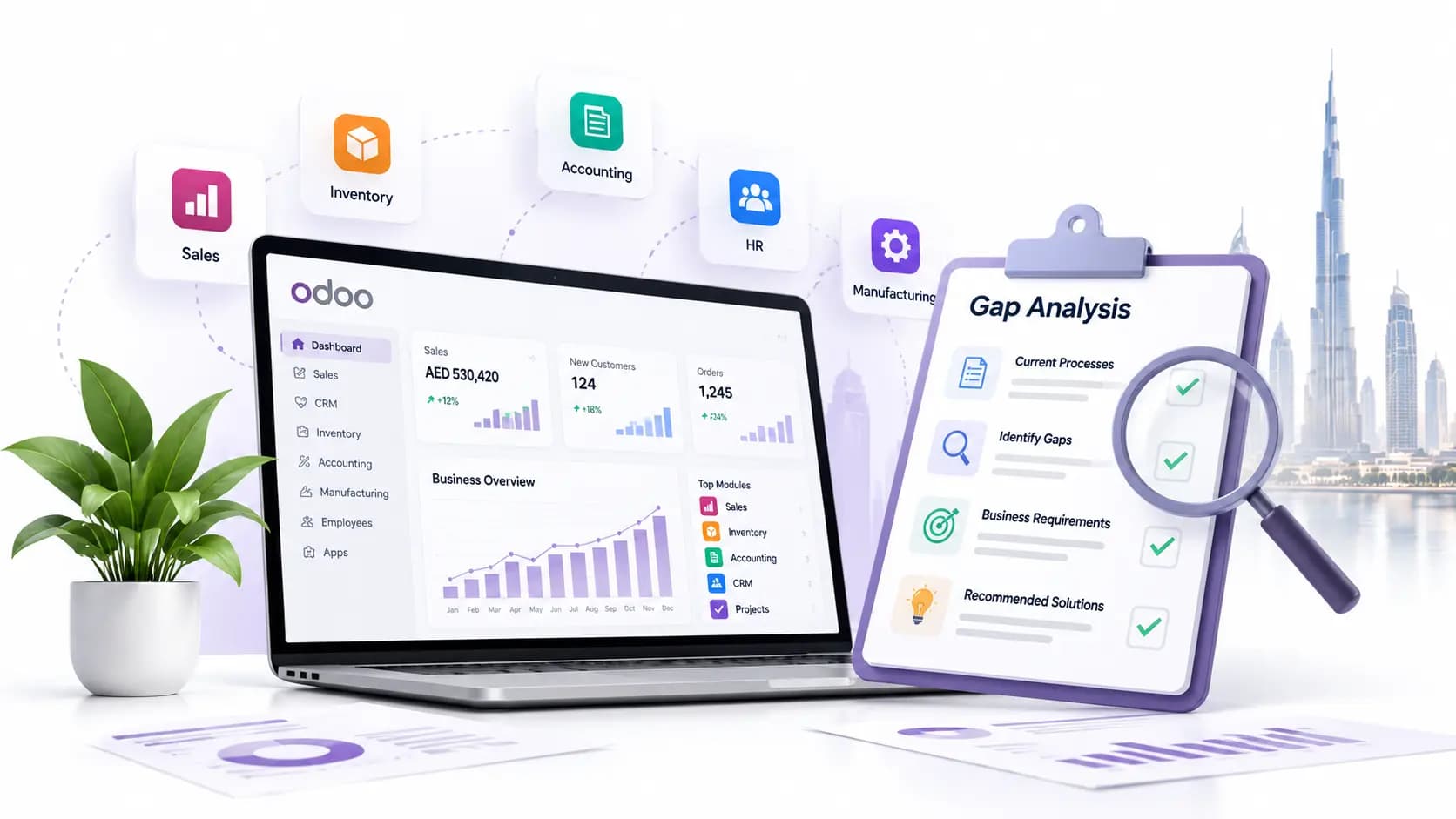
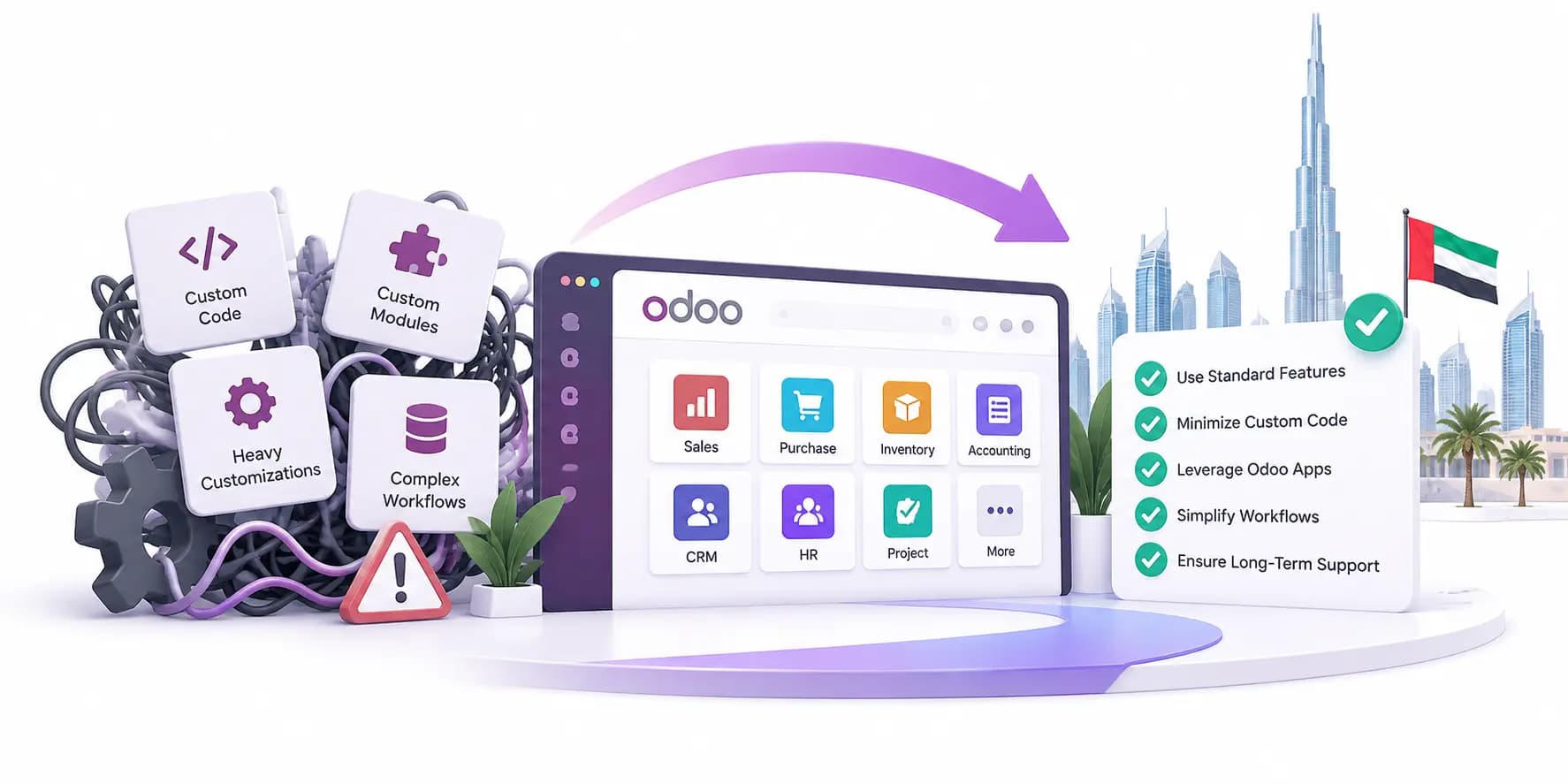
Dubai trading companies often struggle because a single shipment creates too many moving parts.
When a container lands through Jebel Ali, one team checks the purchase order, another follows up with the freight forwarder, the warehouse waits for clearance, accounts records a supplier bill in a different system, and sales promises stock to a customer before anyone has confirmed what is actually available. By the time the numbers reach management, the margin has already changed.
Quick Answer
Odoo ERP for Import & Export Companies helps trading businesses manage sales, purchasing, inventory, suppliers, customers, warehouses, landed costs, shipments, and accounting through one integrated platform. With real-time stock visibility, automated workflows, multi-currency support, and UAE VAT and e-invoicing readiness, Odoo helps import and export companies improve control, reduce operational delays, and scale efficiently.
Dubai has built an unusually connected trade environment around Jebel Ali, airport-linked free zones such as DAFZA, mainland warehouses, re-export routes, and regional logistics networks. Jebel Ali Port alone connects more than 150 ports through over 80 weekly services, which says plenty about the scale and speed businesses operate at here.
That scale is useful, but it exposes weak systems quickly. In this situation, Odoo gives trading and import/export companies one place to manage stock, purchases, sales, finance, and operational records. It’s important that it does not remove the hard work of buying well or predicting demand. What it does is stop teams from arguing over which spreadsheet is correct.
Why Trading Companies in Dubai Need an ERP
A growing trading business usually starts with familiar tools like Excel sheets, WhatsApp updates, separate accounting software, and someone who “knows where everything is.” That setup works until the business starts growing.
An ERP like Odoo becomes necessary when daily operations begin to include multiple suppliers, currencies, warehouses, customer price lists, customs documents, and tax records.
Here are the common pressure points:
Stock appears available on paper but sits in another warehouse, under inspection, or has already been committed to a customer.
Purchase costs look simple until freight, insurance, duty, clearing charges, and inland transport arrive later.
Sales teams quote prices in AED, USD, EUR, or another currency. They don’t even see the latest landed cost or exchange-rate impact.
The finance team receives the supplier invoices a long time after goods arrive. It creates a distorted view of actual profitability.
It’s important for free zone and mainland companies to get clearer documentation and stronger control over where goods actually are.
VAT reporting becomes harder when import VAT, local sales, exports, credit notes, and zero-rated transactions stay in disconnected systems.
Odoo does not automatically organise a trading company. But it definitely gives the business a structure where each transaction can leave a trace - quotation, purchase order, receipt, landed cost, delivery, invoice, payment, and report.
Request an Odoo Demo for Trading Businesses
Experience how Odoo manages multi-currency transactions, warehouses, landed costs, and supply chain operations for trading companies in Dubai.
Key Odoo Modules for Import and Export Operations
Inventory and Warehouse Management
For a Dubai trader, inventory is rarely just “in stock” or “out of stock.” Goods can be anywhere, like on the water, at a port, in a free zone warehouse, moving to a mainland location, reserved for a customer, or waiting for quality checks.
Odoo Inventory helps businesses define multiple warehouses and internal locations, track receipts and deliveries, manage replenishment rules, and process inter-warehouse transfers. Its route configuration can automate movements between locations based on defined rules.
This matters when a company stores goods in JAFZA but supplies customers from a mainland warehouse. Instead of treating transfers as informal stock movements, the business can record the movement properly and see the quantity at each location.
A useful setup often includes:
Separate warehouse records for free zone, mainland, showroom, and transit stock
Reserved quantities for confirmed sales orders
Batch or serial tracking for controlled products
Reordering rules for fast-moving items
Internal transfers with approval steps for higher-value stock
But the important point is simple - visibility only works when warehouse users record receipts and dispatches on time.
Purchase Management
Trading margins often disappear before the sale even happens. Buyers accept the supplier quotes, freight rises, the shipment arrives late, and the selling price remains unchanged because sales already promised it to a customer.
Odoo Purchase manages requests for quotation, purchase orders, purchase agreements, vendor price information, and supplier bills. It also supports blanket orders for recurring purchases from the same supplier at agreed pricing.
For importers, purchase management should connect directly with inventory and accounting. A purchase order should not become a separate document that finance discovers only after goods reach the warehouse.
Sales and CRM
Dubai trading businesses often sell through a mix of repeat customers, dealers, project buyers, walk-in clients, and export accounts. These customers do not all need the same pricing, payment terms, or delivery process.
Odoo CRM and Sales allow teams to manage leads, quotations, customer-specific price lists, sales orders, delivery commitments, and invoicing from a connected workflow.
This becomes useful when a sales executive needs an honest answer to a basic question: “Can we deliver this urgently?”
The answer should come from available stock, incoming purchase orders, and warehouse commitments.
Accounting and VAT Compliance
Odoo Accounting can generate tax reports from invoices and vendor bills, based on the tax settings and tax grids configured in the system.
For UAE trading companies, this is valuable because VAT treatment depends on the transaction. Imports, local supplies, exports, designated-zone movements, and certain re-export arrangements require different records and supporting documents. The Federal Tax Authority also treats designated zones under specific VAT rules.
Prepare Your Business for UAE E-Invoicing
Ensure your trading and import/export operations are ready for upcoming UAE e-invoicing regulations with expert Odoo implementation support.
Odoo can support VAT reporting and help prepare FTA-ready records. But the tax setup, transaction coding, documentation, and review process must be right before anyone submits through EmaraTax.
A strong implementation should include:
UAE VAT tax mapping
Proper treatment for sales, purchases, imports, and exports
Clear tax invoice formats
Credit-note controls
VAT report review before filing
Document retention linked to transactions
Import/Export and Customs Documentation
Odoo can organise the commercial side of import and export. It includes purchase orders, sales orders, packing details, commercial invoices, delivery documents, Incoterms, supplier bills, and shipment-related costs. Odoo also allows Incoterms to be added to customer invoices.
Dubai Customs supports declarations for import, export, transit, transfer, and temporary admission. That does not mean a standard Odoo database automatically submits declarations to Dubai Customs.
This distinction matters. Customs or logistics integration usually needs a connector, API-based development, or a process built around the company’s freight forwarder and customs broker. Odoo supports third-party carrier integrations through API credentials, but the exact connection must be scoped carefully.
Final Thoughts
Odoo for Trading and Import/Export Companies in Dubai provides an integrated ERP solution to manage purchasing, sales, inventory, warehousing, customs documentation, logistics, accounting, and multi-currency transactions from a single platform. With Odoo E-Invoicing capabilities and UAE e-invoicing readiness features, businesses can streamline invoice generation, ensure VAT compliance, automate financial processes, and prepare for the upcoming UAE e-invoicing regulations, improving operational efficiency and regulatory compliance across international trade operations.
Odoo suits Dubai trading and import/export companies because it connects the parts of the business that usually drift apart. It includes purchasing, stock, sales, landed cost, VAT records, and delivery.
Its real value is the ability to trace a sale back to the supplier order, shipment cost, warehouse movement, and financial result.
Still, the software is only as useful as the process behind it. A company that treats warehouse receipts casually, ignores landed costs, or assumes customs integration comes prebuilt will remain frustrated, even with a modern ERP.
For trading businesses that want tighter stock control, cleaner reporting, and a more honest view of margins, Odoo can be a practical foundation. The work lies in configuring it around the way goods actually move through Dubai.
FAQ
Why is Odoo suitable for trading and import/export companies in Dubai?
Odoo provides an integrated ERP platform that helps trading and import/export companies in Dubai manage procurement, inventory, warehousing, sales, accounting, logistics, customs documentation, and multi-currency transactions from a single system. It improves operational efficiency, visibility, and compliance with UAE business requirements.
Does Odoo support multi-currency and international trade transactions?
Yes. Odoo supports multi-currency transactions, exchange rate management, international purchasing and sales, landed cost calculations, supplier management, and customer invoicing, making it ideal for global trading businesses operating in the UAE.
Can Odoo manage inventory and warehouse operations for import/export companies?
Yes. Odoo offers advanced inventory management features, including multiple warehouses, batch and serial number tracking, barcode scanning, stock forecasting, replenishment planning, and real-time inventory visibility across locations.
Does Odoo support UAE VAT and e-invoicing requirements?
Yes. Odoo supports UAE VAT compliance, tax configuration, financial reporting, and can be customized to meet upcoming UAE e-invoicing requirements. Businesses can automate invoice generation and prepare for future regulatory changes.
Can Odoo integrate accounting, logistics, and supply chain operations?
Yes. Odoo integrates accounting, purchasing, sales, inventory, logistics, CRM, and supply chain management into a unified platform, helping trading and import/export companies reduce manual processes and improve operational efficiency.
Optimize Multi-Warehouse & Import Processes
Gain real-time visibility into inventory, shipments, landed costs, and warehouse operations with Odoo ERP.
Did You Know?
Trading companies spend up to 30% of operational time managing disconnected systems.
An integrated ERP like Odoo can centralize procurement, inventory, accounting, logistics, and UAE e-invoicing into a single platform.
This results in faster order fulfillment, improved cash flow visibility, and better regulatory compliance.
Related Articles
Explore more insights, ideas, and practical knowledge from our latest writings.
We work with our global presence and keep our advice practical, response times reasonable, and provide solutions that are aligned with the way local companies operate each day.
Market Context
Deep knowledge of UAE rules and expectations.
Trusted Network
Working connections across businesses, sectors, and communities.
Local Assistance
We have a local team that answers clearly when something genuinely needs attention.
UAE Presence
Our team works from the UAE, supporting companies that keep its economy moving.