Advantages and disadvantages of the Odoo ERP system
S
Sophia
Author
Published: 02 Jul 2026
Last Updated: 02 Jul 2026
Approx. Read Time: 10 mins
ERP conversations in the UAE now begin at the invoice screen. Finance teams want customer details, tax codes, product information, and approval records to arrive correctly the first time. UAE electronic invoicing gives businesses another reason to bring these details into one controlled workflow.
The Ministry of Finance started the pilot and voluntary e-invoicing phase on 1 July 2026. Its published plan sets 1 January 2027 for businesses with annual revenue of AED 50 million or more, and 1 July 2027 for businesses below that threshold. It means businesses need to prepare their ERP or accounting applications for integration and testing with an Accredited Service Provider, or ASP.
As a solution, Odoo can help bring sales, inventory, accounting, purchasing, HR, and invoicing into one system. Still, you must remember it is not a magic fix for messy processes, but it gives a business structure.
What Is Odoo?
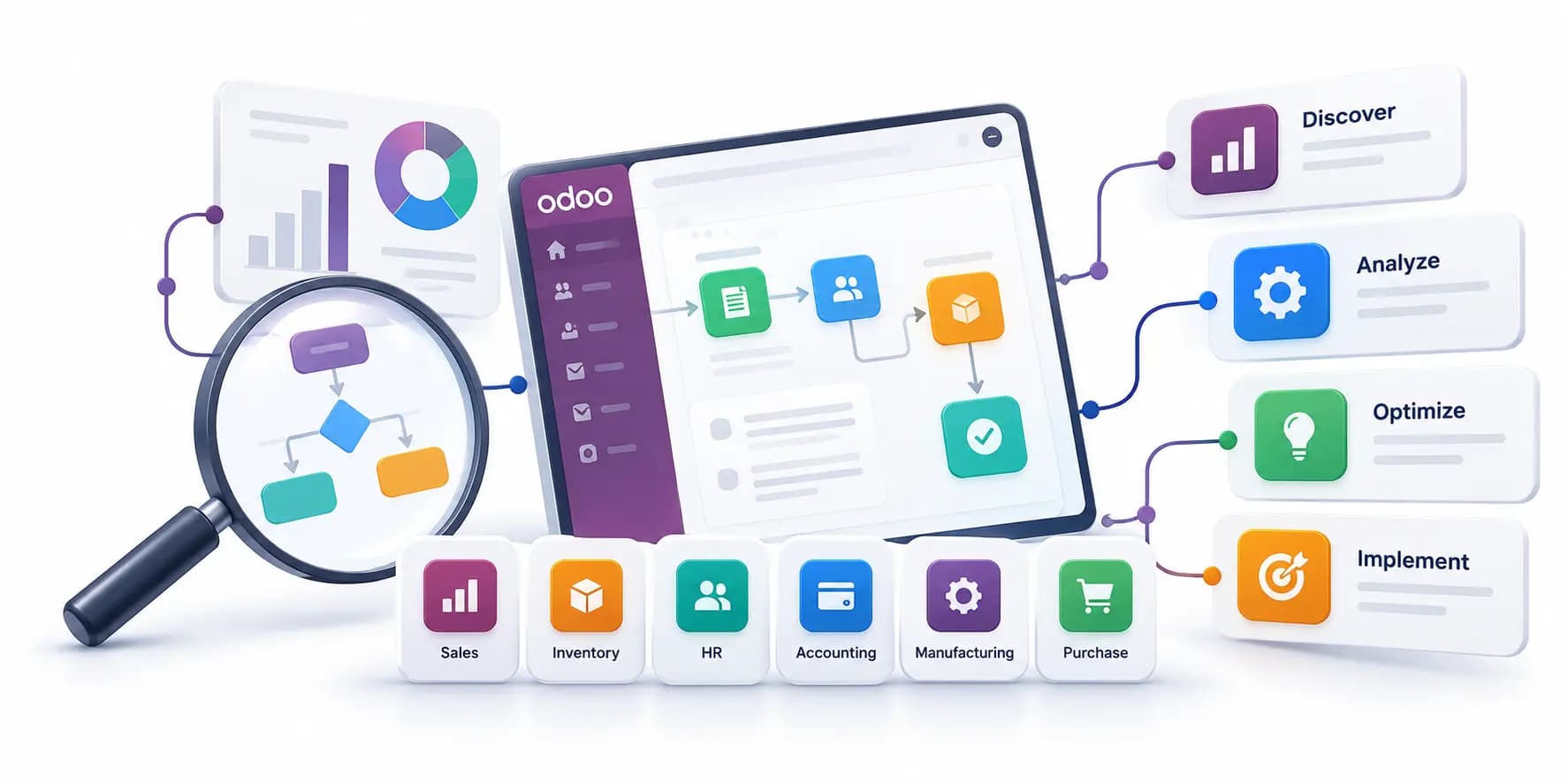
Odoo is a suite of connected business applications covering CRM, sales, accounting, inventory, point of sale, eCommerce, projects, and manufacturing.
Odoo comes in Community and Enterprise editions.
Community provides the free, open-source core.
The Enterprise version of Odoo adds features and subscription services. It includes support, upgrades, and hosting.
Your needs for applications, budget, and technical capacity help determine which version is right for you.
Odoo’s Uniqueness for Businesses
Open Source
Odoo Community gives businesses a foundation they can inspect, host, and extend. This flexibility matters for particular approval routes, industry forms, and internal controls. You can add a useful feature that solves a recurring issue, such as a delivery approval step or essential report field.
Easy-to-Understand Interface
Odoo uses app-based screens, dashboards, forms, and action buttons that follow daily work. A salesperson can move through lead, quotation, order, and invoice. Warehouse staff work with receipts, transfers, and deliveries in the same system. Focused menus and role-based training help the system feel clear during a busy afternoon.
Get a Free Odoo ERP Consultation
Speak with our Odoo experts to evaluate your business requirements, discuss implementation strategies, and identify the right Odoo modules for your organization.
Modular Architecture
Odoo works through modules. You can start with modules like CRM, sales, and invoicing. Then you can add more features that include purchase, inventory, manufacturing, projects, helpdesk, or HR as your operations expand. For example, a distributor can focus on purchase, sales, inventory, and accounting. Manufacturers can add bills of materials and work orders when ready.
Why Odoo Feels Different
Customizability
Growing businesses carry details that matter. It includes approval limits, Arabic and English documents, branch-level price lists, project codes, or warehouse rules. Odoo gives consultants room to reflect these realities.
Strong customisation stays close to a clear process. A reliable consultant always asks if a request improves speed, control, or reporting before it becomes code. That keeps upgrades easier to manage.
A Suite of Integrated Applications
Integration becomes valuable when a customer asks where an order stands. Odoo can trace the same thread through quotation, order, stock availability, delivery, invoice, and payment. Finance sees the commercial event as it happens, while operations work from the same record.
This matters for e-invoicing in Odoo. Strong electronic invoices begin with accurate customer profiles, product data, tax treatment and document references. Odoo gives a business one place to organise source data before invoice information reaches the provider.
Partners
Odoo implementation often depends heavily on the people setting it up. There are multiple providers that offer implementation, development, training, integration, and first-level support. The official partners receive training and can escalate relevant issues through their relationship with Odoo.
Advantages of Odoo
Odoo offers several clear advantages:
Connected records: Sales, purchase, stock, and finance work from shared information. It improves traceability across handovers.
Phased adoption: It means companies can start with their current priorities. After that, they can expand on a stable foundation.
Better visibility: Odoo provides live operational data. It ultimately allows managers to review sales, deliveries, purchases and receivables.
Request a Personalized Odoo Demo
Experience Odoo ERP through a customized demonstration covering accounting, CRM, inventory, manufacturing, HR, and other business processes.
Industry flexibility: Trading, retail, service, manufacturing and project-based businesses can easily use the system. They can shape it around their workflows.
E-invoicing preparation: Centralised customer, product and VAT data supports ASP integration and electronic invoice exchange.
What Type of Companies Can Benefit Most from Odoo?
Odoo is perfect for those companies that have already outgrown spreadsheets, separate accounting tools, and stand-alone stock systems.
UAE trading and distribution firms can add purchasing, warehouses, sales, and accounts.
Retailers may connect point of sale with product and inventory data.
Manufacturers can bring together bills of materials, work orders, procurement and stock movement.
Service businesses can combine CRM, quotations, projects, timesheets and invoices.
It also suits multi-branch companies seeking common rules and branch-level visibility.
Businesses preparing for UAE electronic invoicing benefit from clean source data.
Overall, the strongest fit appears where management settles the basics: customer-record ownership, price lists and the point when a sale moves to invoicing.
Where Odoo Becomes A Bit Tricky
Support and Maintenance
Odoo needs attention after go-live. Users have questions, integrations change, updates arrive, and a small configuration choice can affect a report. Companies that treat support as an optional extra often fall back on workarounds until month-end exposes the problem.
Solution: A support plan should define response expectations, backups, version updates, user assistance, and responsibility for custom code. A business needs to know who can fix a real issue.
Hard to Learn
Odoo’s interface is approachable, but ERP work itself is demanding. A warehouse user may understand the screen and still struggle with confirming receipts properly. An accountant may know the ledger and need time to trust automated flows. The harder part is often changing small habits people have followed for years.
Solution: Training should match daily roles. Short role-based sessions, test transactions, and one visible internal owner work better.
Customization Complexity
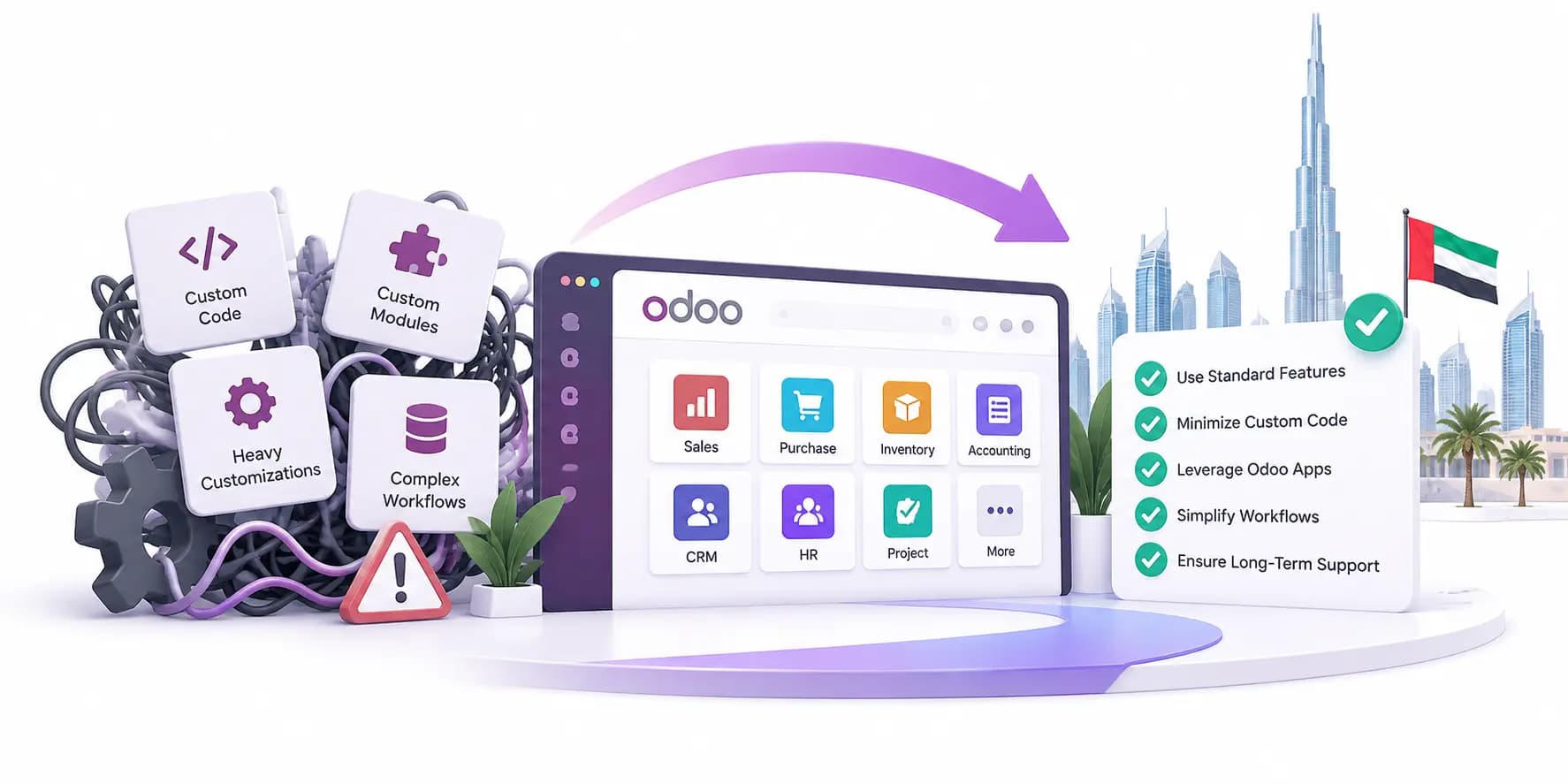
Odoo Customization can make Odoo better, but it can also create a maintenance commitment. For example, custom modules need documentation and testing besides review during upgrades. Integrations need error handling. Special approval flows need clear ownership. When every department receives its own exception, the system becomes fragile and expensive to update.
Solution: The practical rule is simple. Configure first, customize second, and build only where there is a genuine business case. Not every spreadsheet deserves to become a module.
Conclusion
Odoo offers a capable option for UAE businesses seeking connected operations and room to adapt. Its modular applications, open-source Community Foundation, integrated records, and customisation options can support daily control as well as a structured route toward UAE electronic invoicing.
Get an Odoo Implementation Quote
Receive a tailored Odoo ERP proposal with pricing, implementation timelines, customization scope, deployment options, and support plans.
For Odoo ERP consultation, implementation, customisation, training and ongoing support in the UAE, contact Penieltech. The right consultation turns an early software discussion into a system plan your team can use every day.
FAQ
What are the main advantages of Odoo ERP?
Odoo ERP offers a modular architecture, user-friendly interface, extensive customization options, integrated business applications, scalability, and support for multiple industries. Businesses can implement only the modules they need and expand the system as their operations grow.
What are the disadvantages of Odoo ERP?
Some challenges of Odoo ERP include implementation complexity, customization costs, the need for technical expertise, ongoing maintenance requirements, and potential upgrade challenges for heavily customized deployments.
Is Odoo ERP suitable for small and medium-sized businesses?
Yes. Odoo ERP is widely used by small and medium-sized businesses because it provides flexible deployment options, affordable entry costs, modular functionality, and the ability to scale as business requirements evolve.
Does Odoo ERP require customization?
Not always. Many businesses can begin with standard Odoo modules and configurations. Customization should only be considered when specific business processes cannot be managed effectively using standard functionality.
Is Odoo ERP a cloud-based or on-premise solution?
Odoo ERP supports both cloud and on-premise deployment models. Businesses can choose the deployment option that best matches their operational requirements, budget, security policies, and IT infrastructure.
Related Articles
Explore more insights, ideas, and practical knowledge from our latest writings.
We work with our global presence and keep our advice practical, response times reasonable, and provide solutions that are aligned with the way local companies operate each day.
Market Context
Deep knowledge of UAE rules and expectations.
Trusted Network
Working connections across businesses, sectors, and communities.
Local Assistance
We have a local team that answers clearly when something genuinely needs attention.
UAE Presence
Our team works from the UAE, supporting companies that keep its economy moving.