Which ERP Software Is Best for UAE Businesses in 2026?
D
Daniel
Author
Published: 06 Apr 2026
Last Updated: 29 Apr 2026
Approx. Read Time: 9 mins
Choosing ERP software in the UAE is rarely just a software decision. It usually starts with a very practical problem. Finance teams want VAT handled properly. Management wants better reporting. Operations want fewer manual handovers. Sales wants visibility. And somewhere in the middle of all that, the business realizes that spreadsheets, disconnected tools, and patchwork systems are no longer enough.
That is where the ERP discussion becomes serious. In the UAE market, five names come up again and again - Odoo ERP, SAP Business One, Oracle NetSuite, Microsoft Dynamics 365, and TallyPrime. All five are capable systems. All five can work in the right setup. But they do not serve the same type of business in the same way. The real difference is not only in features. It is basically in the fit.
What UAE businesses usually need from an ERP
A business operating in Dubai, Abu Dhabi, Sharjah, or anywhere else in the UAE usually looks for a few non-negotiables first.
VAT at 5% has to be handled correctly.
FTA reporting must be manageable.
Multi-currency is important for companies dealing in AED and foreign trade.
Arabic or bilingual invoicing is also crucial depending on customers and operational needs.
On top of that, businesses want software that can grow with them instead of forcing another replacement two years later.
Why Odoo stands out in the UAE
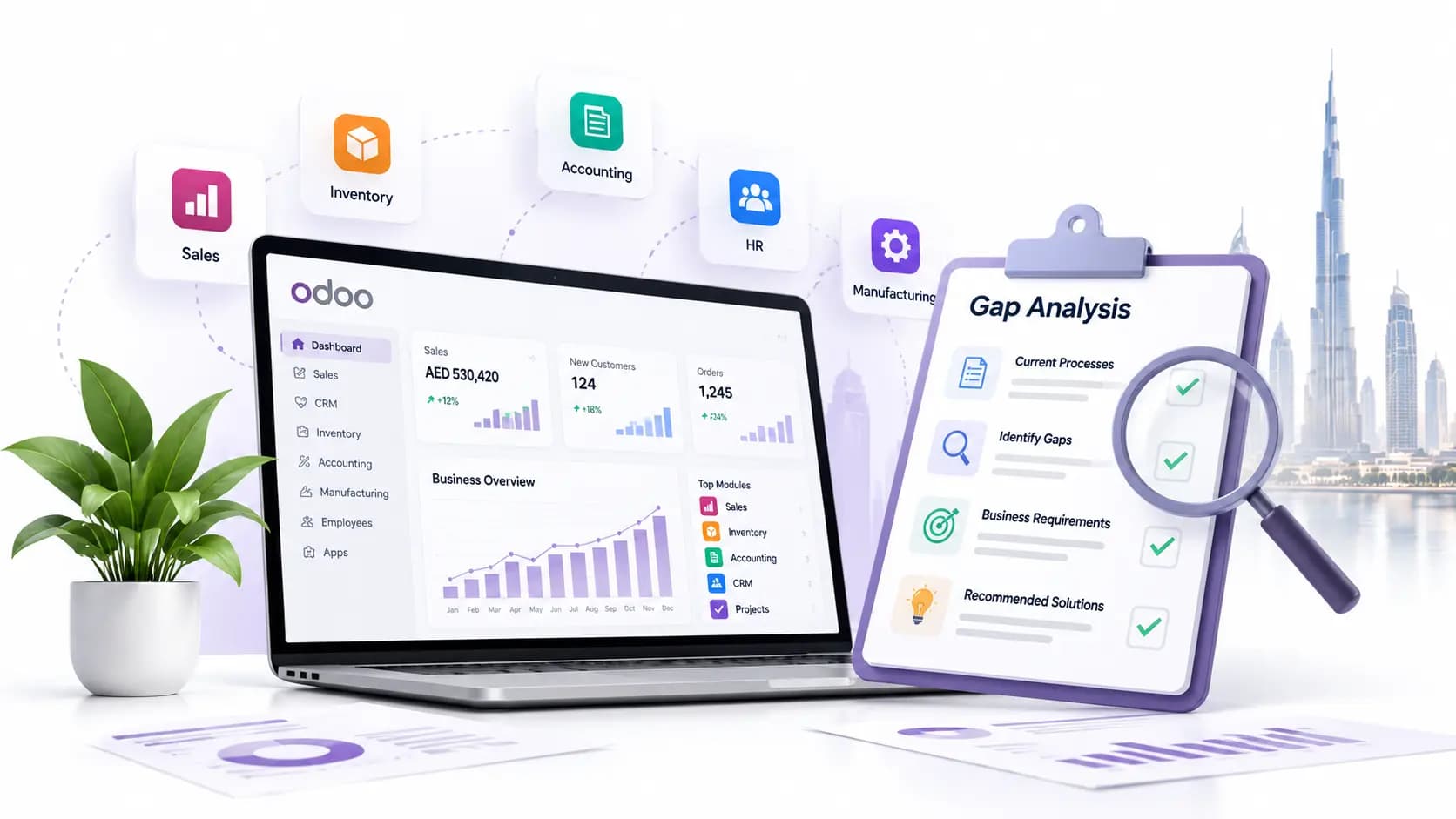
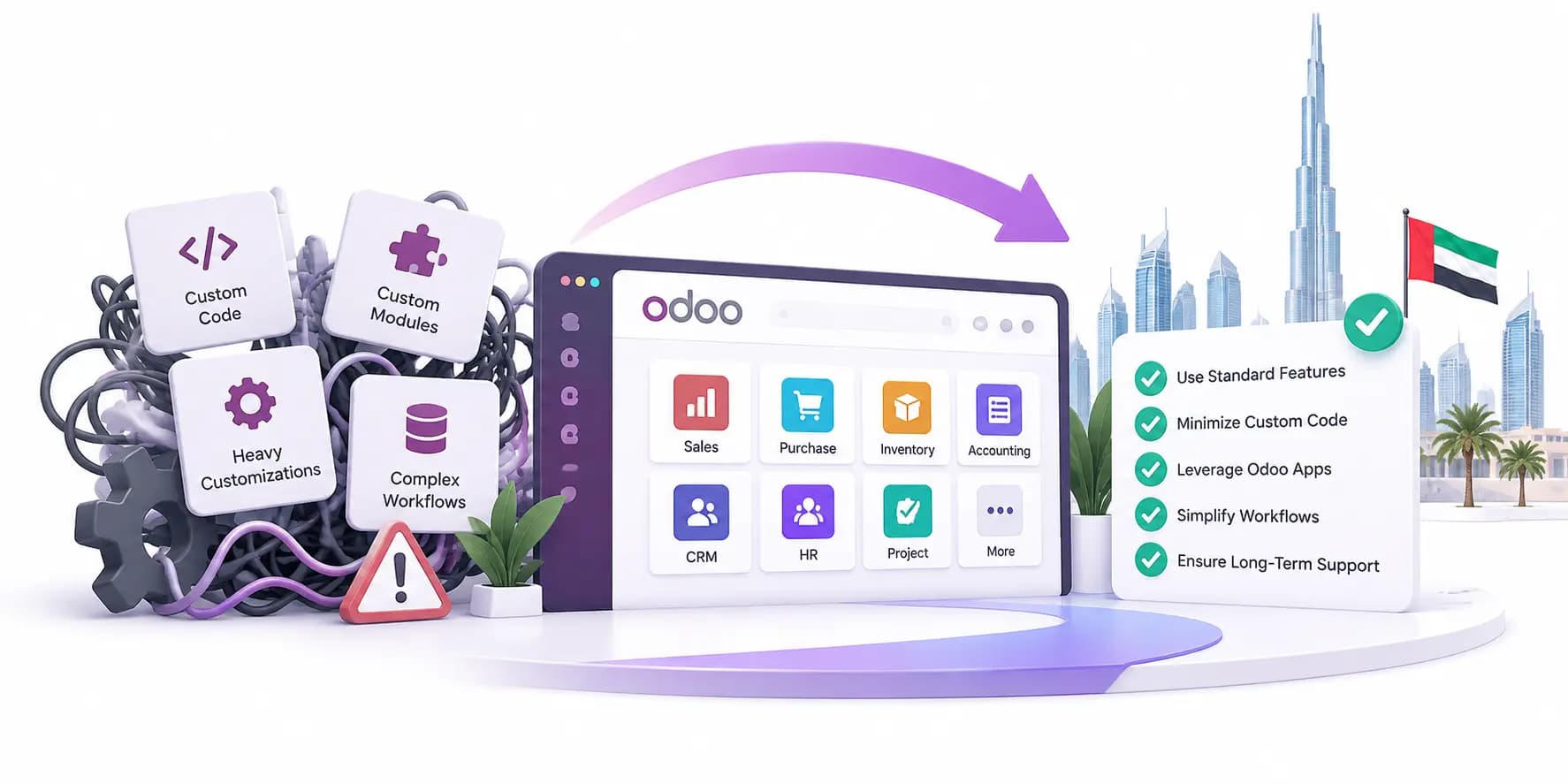
Odoo is often the most attractive option for UAE SMEs because it gives businesses flexibility without immediately pushing them into a heavyweight enterprise structure. That balance is important. Many companies in the UAE do not need a rigid ERP with months of overhead before they see value. They need something practical, modular, and adaptable.
That is where Odoo does well.
It supports UAE VAT through localization.
Includes a UAE chart of accounts.
Supports reverse charge mechanism.
Can generate invoices in English, Arabic, or both.
Updates exchange rates using the UAE Central Bank service by default.
It also offers cloud-based deployment options through Odoo’s own ecosystem, which fits the ongoing demand for cloud ERP in the region.
For UAE businesses, the biggest strength of Odoo is not just compliance. It is the system's flexibility. A company can begin with accounting, invoicing, inventory, CRM, or sales, then expand gradually into manufacturing, service, ecommerce, HR, or field operations.
That makes it a strong fit for SMEs and mid-sized businesses that want room to grow without changing platforms too early.
Its pricing is also generally more approachable than premium ERP suites, though the final cost still depends on apps, hosting, customization, and partner scope.
Is Odoo the Right ERP for Your UAE Business?
From UAE VAT compliance and Arabic invoicing to modular growth across departments — Odoo can be configured to fit how your business actually works. Talk to a local expert before you decide.
Where SAP Business One fits
SAP Business One tends to suit businesses that want a more structured ERP environment from the beginning. In the UAE, it is commonly chosen by process-driven SMEs, especially in manufacturing, trading, and distribution setups where internal discipline matters as much as reporting.
SAP supports UAE finance localization. It also supports multi-currency capabilities. In practice, SAP Business One usually works best when the implementation partner understands the local business model properly, because much of the real success depends on how well the system is configured for the company’s workflows.
It is a mature ERP, and that maturity appeals to businesses that prefer a more formal ERP structure.
Where Oracle NetSuite makes sense
NetSuite is usually strongest when the business is already thinking bigger. It is especially appealing for companies with multi-entity operations, international subsidiaries, more complex reporting, or cloud-first expansion plans.
For the UAE market, NetSuite offers strong tax reporting support. Oracle provides UAE VAT reporting in PDF and XLS formats and also supports UAE tax audit file capabilities. That makes it a serious option for companies that want a cloud-native ERP with stronger global depth.
The reason some businesses choose NetSuite is simple: growth. It is designed for businesses that are growing beyond straightforward local operations. It is usually a premium ERP investment, and makes the most sense when the business genuinely needs that broader structure.
Why Microsoft Dynamics 365 remains a strong contender
Microsoft Dynamics 365, especially Business Central in SME discussions, is often a natural fit for businesses that are already comfortable with Microsoft products. If a company already works heavily with Microsoft tools, the transition feels more familiar.
Microsoft’s official pricing for Business Central starts at $80 per user per month for Essentials and $110 for Premium.
In the UAE, Dynamics 365 is usually a good fit for businesses that want strong cloud capability, dependable financial management, and a familiar enterprise environment. It is a strong option, especially when the right partner handles localization and implementation.
Why TallyPrime matters in the UAE
TallyPrime is sometimes underestimated in ERP discussions because people often associate it mainly with accounting. But in the UAE, that is exactly why it still matters. Many SMEs are finance-led businesses. Their biggest pain points are VAT, day-to-day accounting, reporting, invoicing, and control. For that type of company, TallyPrime remains highly relevant.
Tally’s regional positioning emphasizes VAT compliance, bilingual invoicing, and connected VAT return workflows. The software also supports direct UAE VAT 201 upload and submission from TallyPrime to the EmaraTax portal. In the UAE market, public pricing commonly shows around AED 2,340 for Silver and AED 7,020 for Gold, making it one of the most cost-effective options for finance-centric businesses.
For businesses that mainly want accounting strength, cost control, and faster go-live, TallyPrime is still a very practical choice.
So which ERP is better?
If the business wants the best balance of flexibility, UAE localization, modular growth, and cost control, Odoo is usually the strongest all-round choice. Its strength is that it can start small, adapt well, and grow across departments without feeling too rigid.
If the business wants a mature and structured ERP framework, SAP Business One is a strong choice.
If it wants a global cloud ERP for multi-entity growth, NetSuite is often the better fit.
If it prefers the Microsoft ecosystem and strong cloud business applications, Dynamics 365 is a serious contender.
If the business is finance-heavy and wants a familiar, cost-effective system with strong UAE VAT practicality, Tally remains one of the smartest options.
Comparison Table
Feature / UAE Requirement
Odoo ERP
SAP Business One
Oracle NetSuite
Microsoft Dynamics 365
TallyPrime
UAE VAT Compliance (5%)
Strong UAE localization with VAT-ready setup, UAE chart of accounts support, reverse charge handling, and bilingual invoice support.
Supports VAT and localization-led compliance for UAE projects through implementation and configuration.
Strong UAE tax support with UAE tax codes, VAT report, VAT adjustments, and UAE tax audit file support.
Strong UAE VAT setup/reporting support; Microsoft documents UAE VAT setup and reporting for Dynamics.
Strong fit for UAE VAT workflows, with connected e-VAT filing and VAT-focused usage in the regional Tally market
FTA Reporting (UAE)
Good support through UAE localization and accounting configuration; commonly used for UAE VAT reporting workflows.
Commonly configured by partners for FTA-aligned reporting in UAE deployments.
Very strong; UAE VAT report is available in PDF/XLS and supported through NetSuite tax reporting tools.
Strong; Microsoft provides UAE VAT reporting setup, and partner localization apps add FTA-focused output where needed.
Strong for day-to-day SME tax reporting in the UAE, especially for accounting-led businesses.
Arabic Language Support
Supports additional languages; UAE localization supports invoices in English, Arabic, or both.
Arabic support is available in SAP ecosystems and local deployments can be localized for Arabic-speaking teams.
Supports Arabic in multi-language environments and printed forms/localized content scenarios.
Arabic is available through partner language packs/localizations for Business Central in markets like the UAE.
Strong regional fit with bilingual English-Arabic invoicing in UAE deployments.
Multi-Currency (AED + Global)
Strong; supports currency exchange rate updates and UAE Central Bank-based exchange service by default.
Strong multi-currency support in finance setup.
Very strong; widely used for international, multi-subsidiary, multi-currency operations.
Strong; widely adopted for multi-currency finance and regional operations.
Good for SMEs and many trading businesses; supports UAE and practical cross-currency accounting needs.
Local Business Fit (SMEs in UAE)
Excellent fit for SMEs that want flexibility, modular rollout, and strong local adaptation.
Strong fit for structured SMEs that want a mature ERP with partner-led implementation.
Strong fit for scaling and upper-midmarket businesses with broader process needs.
Strong fit for SMEs already comfortable with the Microsoft ecosystem.
Very strong fit for accounting-first SMEs and businesses that want a familiar finance-led system.
Customization for UAE Laws
High flexibility; one of Odoo’s biggest strengths is adapting workflows, reports, modules, and compliance logic to local needs.
Strong; usually handled through partners, add-ons, and implementation design.
Strong; powerful customization and localization through SuiteApps and partner delivery.
Strong; partner localization apps and extensions are common in UAE deployments.
Good for statutory and accounting-led requirements; more focused than full-suite ERP customization.
Cloud Adoption (UAE Trend)
Strong cloud story with Odoo Online and Odoo.sh, well aligned with UAE cloud ERP demand.
Available in cloud and on-premise models depending on partner approach.
Excellent; cloud-native by design.
Excellent; cloud-first adoption is a major strength.
Available in cloud deployments through partners, though traditionally strongest in finance-led desktop/LAN environments too.
Industry Use Cases (UAE)
Very broad: trading, retail, services, manufacturing, construction, eCommerce, real estate, distribution, and more.
Strong in manufacturing, trading, distribution, and process-driven SMEs.
Strong in wholesale, distribution, eCommerce, multi-entity, services, and international growth models.
Strong in finance, distribution, services, retail, and businesses already using Microsoft tools.
Strong in accounting, trading, retail, and smaller operational environments.
Implementation in UAE
Usually partner-led and relatively modular; often easier to phase by department.
Structured and well-established partner approach in the UAE.
Delivered through specialized partners; best suited to well-defined transformation projects.
Strong partner ecosystem and Microsoft-led business app familiarity help adoption.
Usually straightforward for finance-led setups and can go live quickly for many SMEs.
Cost in UAE Market
Usually one of the most budget-friendly full ERP options for SMEs.
Mid-to-premium SME ERP investment.
Premium cloud ERP investment.
Mid-to-premium, depending on modules and licenses.
Very cost-effective, especially for finance-centric businesses.
Pricing (UAE Estimate)
Approx. AED 75–100/user/month for cloud subscription before partner services; actual quote depends on edition, apps, hosting, and deal terms.
Usually quote-based in UAE; pricing depends on license type, deployment, users, and partner scope.
Usually quote-based; Oracle/partner pricing depends on modules, entities, users, and scope.
Official list pricing starts at $80/user/month for Essentials and $110/user/month for Premium, before localization and partner services.
Official MENA pricing shows AED 2,340 single-user perpetual and AED 7,020 Gold unlimited multi-user perpetual; annual TSS is extra.
Customization
Excellent
Strong
Strong
Strong
Good
Ease of Use
Very user-friendly and modern for SMEs
Structured and mature
Powerful and enterprise-friendly
Familiar for Microsoft users
Very familiar for finance teams
Best For (UAE)
SMEs and mid-sized businesses that want flexibility, strong localization, and room to grow.
Process-driven SMEs needing a mature ERP structure.
Businesses invested in Microsoft tools and cloud apps
Accounting-focused SMEs and businesses prioritizing simplicity and cost control
So, there is no universal winner in ERP. There is only the right fit for the business model, the team, and the stage of growth.
But for many UAE SMEs, Odoo tends to stand out because it solves a real problem that businesses here constantly face. They want proper ERP control without being trapped in an oversized system too early.
That is why Odoo keeps coming up in serious ERP conversations across the UAE. It gives businesses space to structure operations properly, stay aligned with local requirements, and still remain flexible as they grow.
Ready to Choose the Right ERP for Your UAE Business?
You've compared the options. Now get clarity on which ERP fits your team, your industry, and your budget — with a no-pressure consultation from a certified UAE partner.
FAQs
Which ERP is best for UAE businesses?
There is no single ERP that is best for every UAE business. The better choice depends on what the company actually needs. Some businesses need flexibility and room to grow. Some need a stronger financial structure. Some want cloud depth, and others simply want practical accounting control. For many UAE SMEs, Odoo often stands out because it offers a strong balance between flexibility, localization, and cost.
Is Tallyprime still relevant when compared with full ERP systems?
Yes, absolutely. Tallyprime still matters a lot in the UAE, especially for businesses that are heavily focused on accounting, VAT, invoicing, and financial reporting. It may not always be chosen for broader operational transformation in the same way as some larger ERP suites, but for finance-led businesses, it remains a very practical and cost-effective option.
Which ERP is easier to use for everyday teams?
That depends on the team, but Odoo is often seen as one of the more user-friendly options for SMEs because of its modern interface and modular layout. Tally feels very familiar to finance teams. Microsoft Dynamics 365 often feels easier for businesses already used to Microsoft tools. Ease of use is less about marketing claims and more about which environment feels natural to the people using it daily.
Is Oracle NetSuite a good ERP for UAE companies?
Yes, it is a very strong option, especially for companies thinking beyond basic local operations. NetSuite usually makes more sense for businesses with bigger reporting needs, international activity, multiple entities, or broader expansion plans. It is not always the first choice for smaller businesses, but for companies growing into a more complex structure, it can be a very capable system.
Does Odoo support UAE VAT requirements properly?
Yes, it does, and that is one of the reasons it is often taken seriously by UAE businesses. With the right setup, Odoo can support UAE VAT workflows well, including localization needs, reverse charge handling, chart of accounts alignment, and bilingual invoicing. For companies that want an ERP that can manage day-to-day operations and still stay aligned with local compliance needs, that makes a real difference.
Related Articles
Explore more insights, ideas, and practical knowledge from our latest writings.
We work with our global presence and keep our advice practical, response times reasonable, and provide solutions that are aligned with the way local companies operate each day.
Market Context
Deep knowledge of UAE rules and expectations.
Trusted Network
Working connections across businesses, sectors, and communities.
Local Assistance
We have a local team that answers clearly when something genuinely needs attention.
UAE Presence
Our team works from the UAE, supporting companies that keep its economy moving.