The first software quote is rarely the number a UAE business should use for budgeting.
Quick Answer
Software implementation in the UAE typically takes 8-15 weeks for a focused system and three to six months for a larger ERP. Costs can range from AED 5,000 for simple projects to AED 650,000+ for enterprise setups. Scope, migration, integrations, customization, training and support usually decide the final figure.
A CRM may have an attractive monthly subscription, while the actual project also involves configuration, old customer records, user permissions, integrations and staff training.
ERP takes this further because finance, sales, inventory, purchasing and operations are all connected to the same setup.
For planning purposes, a straightforward UAE software implementation may start around AED 5,000-30,000. A multi-module ERP can sit around AED 40,000-150,000, while larger enterprise implementations can reach AED 220,000-650,000 or more. Current UAE market guides show similarly wide ranges because scope matters far more than company headcount alone.
Similarly, a focused project may go live in 8-15 weeks. A larger ERP with integrations, historical data and several departments commonly needs three to six months or longer.
Here is what actually happens between signing the proposal and using the system every morning.
What Is Software Implementation?
Software implementation is the work required to turn software into a usable business system.
It normally includes selecting the right setup, documenting requirements, configuring modules, adjusting workflows, migrating existing data, connecting other applications, testing the system, training users and going live.
The software might be an ERP, CRM, HRMS, accounting platform, property system or industry-specific application.
Buying software gives you access to a product. Implementation makes that product understand how your company handles a sales order, approves a purchase, or calculates VAT.
The 5-Phase Software Implementation Process
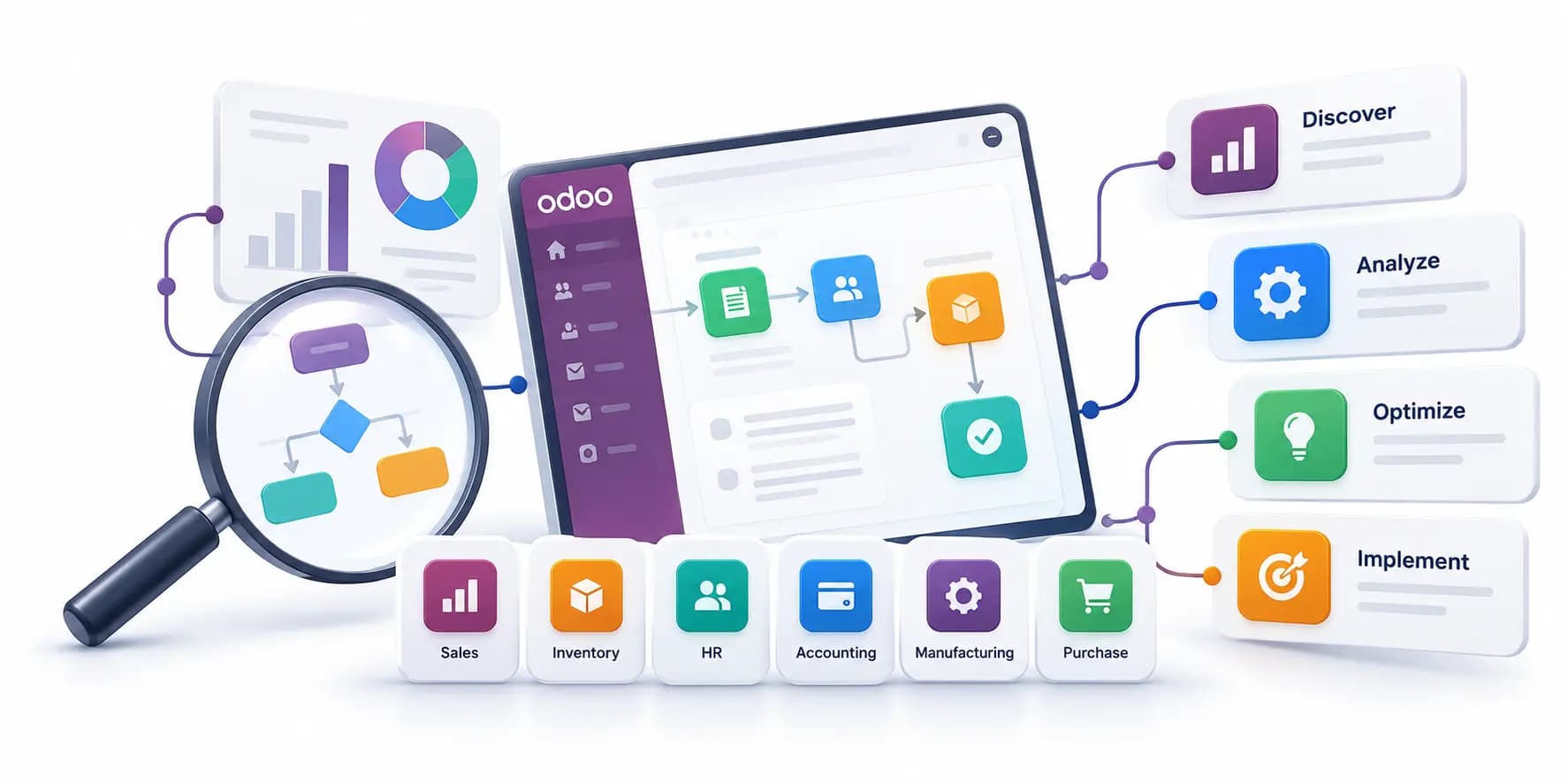
Phase 1: Discovery and Requirements: 2-4 Weeks
The discovery phase is where the implementation team learns how the business actually works.
Expect process-mapping sessions covering sales, purchasing, finance, inventory, HR and other relevant departments. They review existing spreadsheets and software and identify gaps. In this process, requirements are also separated into standard features, configuration, integrations and genuine customization.
Phase 2: Configuration and Customization: 2-4 Weeks
The implementation team now configures the agreed system.
That includes company structures, users, tax settings, products, warehouses, approval levels, document formats, dashboards, payroll rules and access permissions.
Standard configuration deserves preference where it genuinely fits. Custom development makes sense where the business has a real operational requirement rather than simply recreating every habit from the previous system.
Phase 3: Data Migration and Integration: 2-3 Weeks
In this process, existing customer, supplier, employee, stock and accounting data need to be cleaned, mapped and imported.
This phase often takes more thought than businesses expect. For example, ten thousand orderly customer records can be easier to migrate than 2,000 records containing duplicate names, old TRNs and several versions of the same supplier.
Integrations may also connect banks, payment gateways, e-commerce platforms, payroll tools, logistics systems and other applications.
UAE businesses preparing for e-invoicing should also consider how accounting or ERP data will connect with an Accredited Service Provider.
Phase 4: Testing and UAT: 2-4 Weeks
User Acceptance Testing should use real business situations.
It includes creating an actual sales order and applying a discount. There are also steps like processing VAT, receiving partial stock, returning an item, approving an expense, and finally, closing a payroll period.
Your finance, sales, warehouse and HR users should perform these tests themselves.
Phase 5: Go-Live, Training and Support: 1-2 Weeks
The final stage includes user training, final data migration, access setup, go-live assistance, documentation and support handover.
Training must follow job roles. It’s salient to remember that a warehouse picker does not need the finance controller’s session, and similarly, the finance controller does not need two hours on barcode receiving.
Post-launch support terms should also be written clearly, including response times, escalation routes and the SLA.
How Much Does Software Implementation Cost in the UAE?
Business size
Example system
Estimated cost (Total)
Small business
Cloud accounting or CRM
AED 5,000-30,000
Mid-size
ERP with 3-5 modules
AED 40,000-150,000
Enterprise
Multi-branch ERP with integrations
AED 220,000-650,000+
Four things move the number quickly:
Users and modules: finance alone is very different from finance, HR, CRM, inventory, manufacturing and procurement together. So user numbers and modules can affect the cost.
Customization: standard workflows require less development than company-specific processes. This matters when it comes to the cost.
Data migration: clean master data takes less work than several years of historical records from multiple systems.
Integrations: banks, payment gateways, e-commerce, government services and third-party platforms add technical work. It can increase the cost.
Also budget for licences, hosting, training and internal staff time. In the UAE market, annual ERP support and maintenance is around 15-20% of implementation cost, although the actual figure depends on the SLA and system.
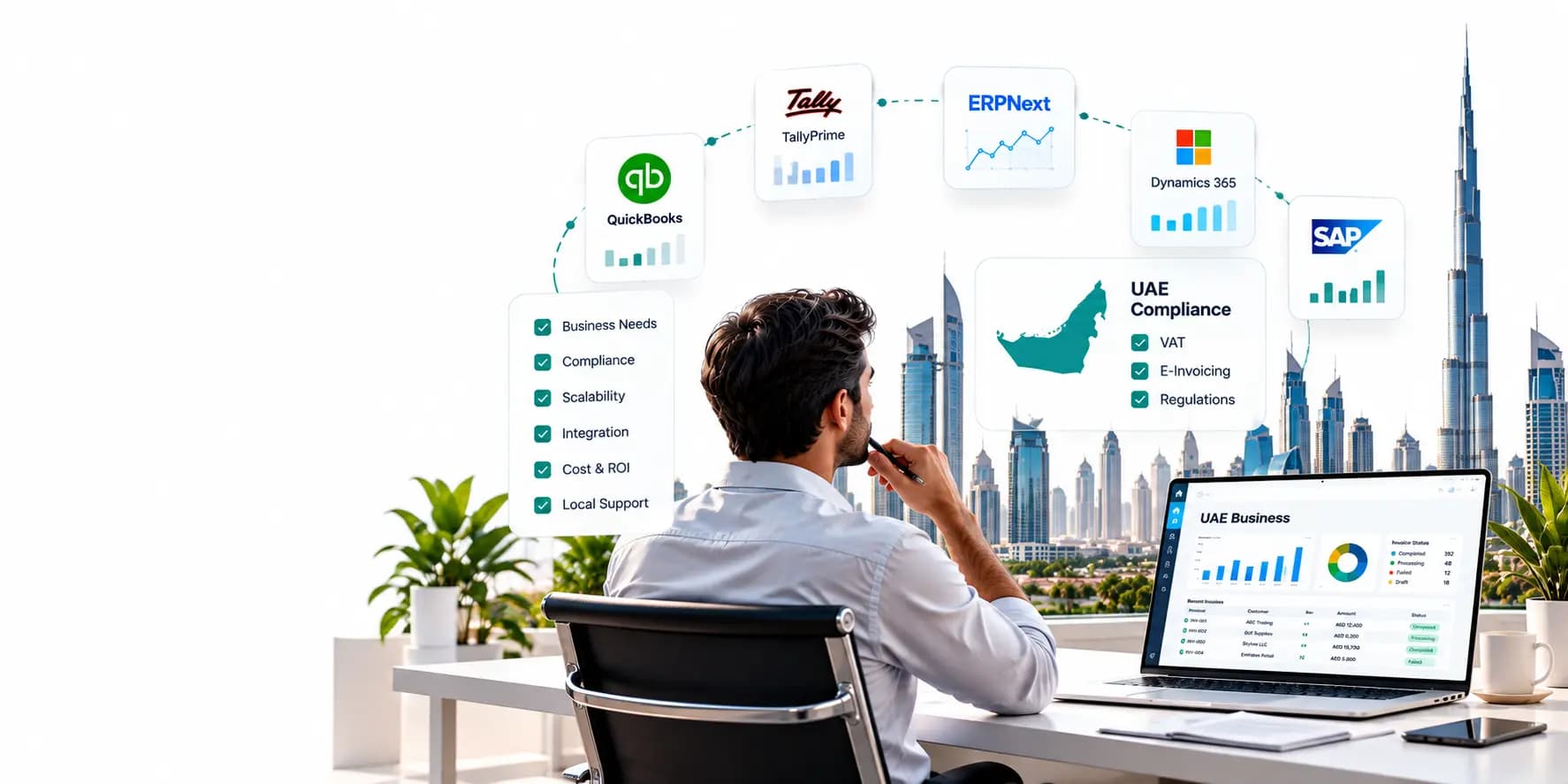
5 Things to Check Before Choosing an Implementation Partner
Discovery happens before the final scope. A serious quotation should reflect your workflows rather than just employee numbers.
Data and IP ownership must be written down. Clarify who owns migrated data, custom code, documentation and integration work.
They need to understand UAE requirements. Ask specifically about VAT, Corporate Tax, e-invoicing, payroll and data protection relevant to your project.
Post-launch support needs to be defined. Ask for response times, support hours, included work and annual charges in writing.
Conclusion
The useful question is not simply, “How much does this software cost?”
Ask instead: What will it take to make this system work properly inside our business?
For many UAE companies, that answer includes discovery, configuration, migration, integrations, compliance work, testing, training and support. Once those pieces are visible, both the budget and timeline become much easier to judge.
FAQs
How long does software implementation take in the UAE?
A smaller CRM, accounting or HRMS project may take around 8 to 15 weeks. ERP usually takes longer because more people, more data and more departments are involved. Three to six months is common. If requirements are still changing halfway through the project, expect the timeline to move too.
What should be the budget for software implementation in the UAE?
A basic implementation may start around AED 5,000-30,000. Mid-size ERP projects can be around AED 40,000-150,000, while larger setups may go well beyond AED 220,000. The licence is only one part of the bill. Migration, integrations, training and custom work can easily change the number.
Why is the final implementation cost higher than the software price?
Because buying the software is the easy part. Someone still has to configure users, tax rules, approvals, reports, workflows and old data. Then there is testing, training and support. A cheap subscription can still turn into an expensive project if the business has complicated processes behind it.
Do we need to migrate all our old data?
Usually, no. Moving ten years of old transactions just because they exist can make the project heavier than it needs to be. Many businesses migrate clean master data, opening balances and the history they genuinely need, while older records stay archived for reference.
Related Articles
Explore more insights, ideas, and practical knowledge from our latest writings.
We work with our global presence and keep our advice practical, response times reasonable, and provide solutions that are aligned with the way local companies operate each day.
Market Context
Deep knowledge of UAE rules and expectations.
Trusted Network
Working connections across businesses, sectors, and communities.
Local Assistance
We have a local team that answers clearly when something genuinely needs attention.
UAE Presence
Our team works from the UAE, supporting companies that keep its economy moving.