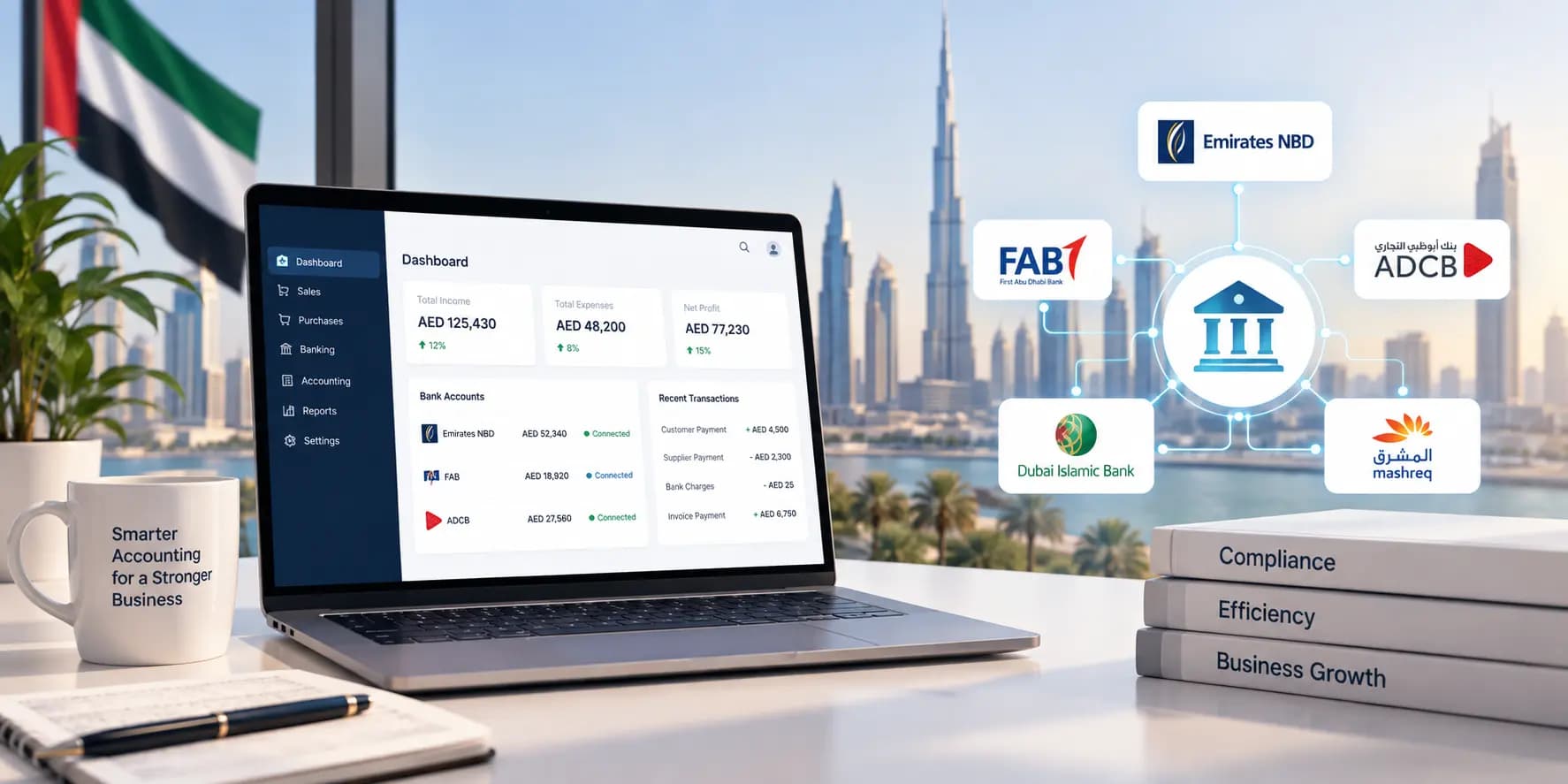
UAE e-invoicing is no longer something finance teams can leave on a later-year checklist. The rollout has started, the technical requirements are published, and mandatory obligations carry real costs. Failure to implement the system or appoint an Accredited Service Provider within the required timeline can attract AED 5,000 for each month or part of a month of delay.
Quick Answer
You probably do not need to replace your accounting software in UAE for e-invoicing. Start by checking PINT-AE compatibility, cleaning customer and tax data, adding mandatory invoice fields, connecting an Accredited Service Provider, and testing real transactions. The weak point is usually data and configuration, not the software itself.
But that does not automatically mean replacing your accounting software.
For many UAE businesses, the practical answer is to clean the existing data, add the required fields, connect the software to an Accredited Service Provider, and test how invoices move from the accounting system into the UAE e-invoicing network.
What Is UAE E-Invoicing and Why Does It Matter?
- Under the UAE framework, an e-invoice is structured invoice data exchanged electronically between a supplier and buyer and reported electronically to the Federal Tax Authority (FTA).
- A PDF attached to an email may look perfectly normal to a customer, but it is not an e-invoice under the programme.
- The UAE uses a Peppol-based, decentralised model. Businesses exchange invoice data through Accredited Service Providers (ASPs), while the relevant tax data is also reported to the FTA.
- The prescribed UAE invoice structure is PINT-AE, with electronic invoices exchanged in XML format.
- The scope covers B2B and B2G transactions, subject to specified exclusions.
Preparation improves the ordinary finance work around an invoice. Cleaner records, quicker validation and fewer corrections can mean invoices move through approval and payment with less chaos.
Step 1: Check if Your Current Software Is Compatible
Do not stop at “Are you e-invoicing ready?” That question is too easy to answer with yes.
Ask if the software can:
- Produce or map invoice data into PINT-AE XML
- Connect with a UAE Accredited Service Provider
- Store all required invoice information
- Process electronic credit notes
- Receive validation and transmission statuses
- Retain invoice data and associated records
The Ministry of Finance currently identifies 51 mandatory fields for a PINT-AE tax invoice. They cover invoice details, seller and buyer information, document totals, tax breakdowns and line-level information.
That distinction matters. Software can print an excellent-looking VAT invoice while still missing structured fields needed behind the scenes.
When to Upgrade Versus When to Replace
An add-on, API connector or vendor module can often solve the problem when the accounting system already stores reliable customer, tax, item and transaction data.
A full replacement becomes worth considering when essential information cannot be stored in structured fields, integration options are very limited, invoice numbering varies without control, or the software cannot support the required invoice and credit-note workflow.
Age alone is a poor reason to replace software. What matters is what the system can store, map and exchange.
Step 2: Audit and Clean Your Invoice Data
This is where preparation becomes very ordinary yet very important.
- Review customer and supplier records for correct legal names, Tax Registration Numbers (TRNs), addresses and duplicate accounts.
- Standardise product and service descriptions, units of measure and tax categories. Then verify the VAT treatment attached to standard-rated, zero-rated and exempt transactions.
Small inconsistencies become visible once structured data is validated automatically. A customer appearing under two slightly different legal names may have gone unnoticed when someone manually checked the invoice. Electronic exchange relies much more heavily on what is actually stored in the database.
Your
accounting system needs to capture required information before the invoice reaches the ASP.
That includes:
- Invoice numbering
- Supplier and buyer legal details
- Tax identifiers
- Invoice date
- Currency
- Payment due date
- Tax category
- Taxable amounts
- Tax amounts
- Quantities
- Item prices
Credit notes deserve the same attention. UAE rules require electronic credit notes in situations including cancelled transactions, reductions in consideration, full or partial refunds, and administrative or numerical errors.
Simply adding another box to the printed invoice is not enough. The value needs to exist as structured data so it can be mapped, validated, transmitted and retrieved.
Step 4: Integrate With an Accredited Service Provider or Access Point
Your accounting software needs a proper route into the UAE e-invoicing network.
- This may be a direct integration between your software vendor and an ASP, or a third-party connector between the accounting system and the accredited provider.
- During setup, configure API credentials, authentication, testing access and secure key management. Map each relevant accounting field to the corresponding PINT-AE element.
- Then decide what your accounting system should record when an invoice is accepted, requires correction, or receives a transmission status. Your finance team should be able to see what happened without searching through a separate technical log every time.
Step 5: Test Before Going Live
- Use the available testing or sandbox environment with transactions that resemble real business activity.
- Test normal tax invoices, zero-rated supplies, foreign-currency transactions, credit notes and returns. Include incomplete sample data as well. Staff should know what a validation issue looks like before they encounter one during live billing.
- Document who reviews validation messages, who can correct master data, who checks invoice status and what process applies during a temporary system interruption.
Common Mistakes to Avoid
- Starting preparation close to the mandatory date compresses data cleaning, field mapping, integration testing and staff practice into the same few weeks.
- Archive planning also deserves attention. UAE guidance requires electronic invoices, credit notes and associated data to remain accessible and reproducible. Standard retention can run for five years, while certain real-estate records require seven years, with extensions applying in specified audit, dispute or voluntary-disclosure situations.
- The other easy mistake is treating e-invoicing purely as an IT installation. The IT department handles the connection. Your finance team still decides if the invoice itself makes sense.
Conclusion
Preparing existing accounting software for UAE e-invoicing is mainly a data, configuration and integration exercise.
Check what your current system can support. Clean customer, supplier and tax data.
Configure the required fields. Connect an Accredited Service Provider. Then test realistic invoices before mandatory implementation.
Replacing software may be the right answer for some businesses. For many others, the better answer is making the system they already use ready for structured electronic invoicing.
FAQs
- Do I need to replace my accounting software for UAE e-invoicing?
Probably not. If the software already stores decent customer, tax and invoice data, an add-on or ASP connection may do the job. Replacing the whole system is an expensive reaction. Check the actual technical gaps first.
- Is a PDF invoice enough for UAE e-invoicing?
No. This is where a lot of confusion starts. A PDF can look perfect and still fail the actual requirement. UAE e-invoicing depends on structured invoice data being exchanged electronically. The appearance of the invoice is almost beside the point.
- Why does old customer data suddenly matter so much?
Because automated validation is less forgiving than a person checking an invoice on screen. A wrong TRN, duplicate customer record or slightly different legal name can become a real problem. Data that looked “good enough” for years may suddenly need proper cleaning.
- How early should we start preparing?
Earlier than feels necessary. Not because the technology is impossible, but because the other parts take time: cleaning records, fixing tax codes, mapping fields, testing odd transactions and deciding who handles errors. Leaving all of that until the deadline is how a manageable project becomes unpleasant.