Inventory Management Challenges in UAE Businesses (2026 Guide to Solving Stock Issues)
By Lisa, on Tue Mar 17 2026
Inventory Management Software
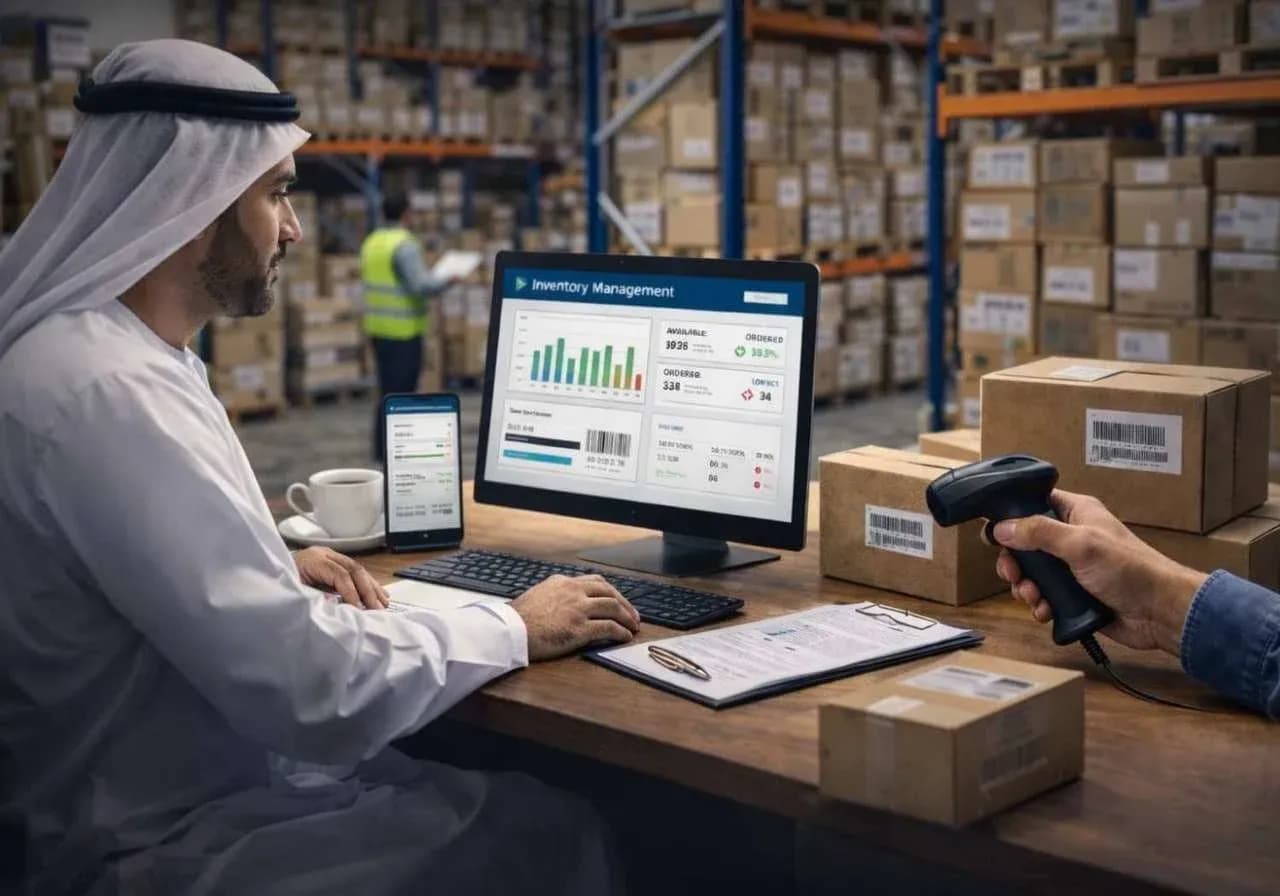
Something has changed in the UAE market, and most businesses can feel it before they can neatly explain it. Here, sales are now moving faster, customer expectations are less forgiving, and warehouses are carrying more SKUs than they did a few years ago. At the same time, orders are coming from physical stores, marketplaces, websites, and WhatsApp. On paper, that looks like growth. Inside the business, it often shows up as serious inventory management challenges UAE.
The UAE’s e-commerce sector has been on a strong upward path, with research saying that in 2024, the market reached almost 32.3 billion, and the target is to cross Dh 50.6 billion by 2029 with a CAGR of 9.4%.
At the same time, the country’s freight and logistics market was valued at USD 21.63 billion in 2025, with further growth expected as trade volumes and distribution complexity increase. That matters because inventory problems do not stay inside the warehouse. They spill into finance, customer service, compliance, and purchasing almost immediately.
A lot of companies still treat inventory as a back-office function. But it is not. It is where your cash stays, mistakes hide, and profit quietly leaks. The usual damage is familiar. You’ll experience stockouts during demand spikes, slow-moving stock that keeps eating capital, mismatched records between branches, and staff spending too much time checking what the system should already know.
That is whyinventory management challenges in UAE businesses are no longer just operational annoyances. They become decision-making problems. They affect margins, tax records, replenishment timing, and customer trust. Today, we’ll talk about seven problems that show up most often in UAE retail and distribution businesses, and how a modern system like Penieltech’s inventory management software fixes them before they turn into expensive habits.
Our solutions help with instant inventory reports, multi-warehouse tracking, stock valuation analysis, and low-stock alerts, which is exactly the kind of stack businesses need when spreadsheets stop coping.
Ready to fix your stock issues before they start costing more? Book a free demo with Penieltech - Click here
Inventory Management Challenges in UAE Businesses (2026 Guide)
Stock outs and overstocking rarely happen separately
Most UAE retailers do not suffer from one inventory problem. They suffer from two opposite problems at the same time. Fast movers go missing when demand spikes, while slow movers stay in storage for months because someone overbought “just to be safe.”
That contradiction is common in growing businesses. Buyers work with imperfect demand signals. Sales teams push for availability. Finance wants less capital tied up. And warehouses want simpler movement. The result is often a shelf that is empty where demand exists and full where it does not.
In Dubai, especially, where promotions, seasonal demand, and tourist-driven buying can shift quickly, forecasting by instinct stops working sooner than people expect.
A system with demand forecasting, reorder points, and low-stock alerts gives the business a chance to respond before panic buying or dead stock takes over.
Supply chain disruptions hit harder when visibility is weak
Supply disruption is not new. What has changed is how quickly it creates downstream damage. A delayed shipment now affects online promises, branch transfers, purchase plans, and customer service responses all at once.
The UAE freight and logistics market continues to expand, but growth itself adds complexity. More cross-border trade, more channel variety, and more customer urgency mean businesses need better live data, not just more warehouse labor. When shipment timing changes, businesses without real-time stock visibility start making defensive decisions: duplicate purchasing, emergency transfers, rushed substitutions, and inaccurate delivery commitments.
This is wherecompanies that are using warehouse inventory solutions in Dubai need to do more than count stock. They need to show what is in transit, what is reserved, what is aging, and what is actually available to sell.
Manual tracking errors still waste more money than people admit
Spreadsheets stay around because they are familiar, not because they are reliable. That distinction matters. A spreadsheet can work for a very small business with simple stock movement. The trouble starts when one product exists in multiple bins, multiple branches, or multiple sales channels.
Manual systems are vulnerable to transposed numbers, duplicate entries, missed updates, and timing gaps between physical stock movement and digital record changes. Often, people consistently underestimate how many errors exist in manual files, and research on manual inventory systems has repeatedly linked record inaccuracies to financial and operational damage.
This is one of the most common stock management problems that retailers in the UAE deal with. Staff end up spending hours reconciling counts, checking branch WhatsApp messages, or walking back to the shelf because nobody trusts the number on screen. That is not a process. That is a coping mechanism.
Multi-location inventory visibility breaks down fast
A single-store inventory setup is one thing. And a business with one warehouse, two retail outlets, and online orders is another. The moment the stock starts moving between Dubai, Abu Dhabi, and Sharjah, businesses need instant synchronization. Without it, one branch may oversell, another hoards stock, and the warehouse becomes the place where everyone sends urgent messages.
The problem shows up in small operational frictions, like the finance team is seeing valuation mismatches, sales promising items that are already committed elsewhere. Over time, those frictions become normal, which is probably the worst part. Teams stop expecting accuracy.
VAT and corporate tax compliance are now inventory problems too
Some businesses still think tax compliance is related only to accounting. In practice, inventory records and tax records connect to each other constantly. Purchase timing, stock valuation, goods movement, damaged stock, returns, and adjustments all create documentation needs.
The FTA has made it clear that businesses must keep records of transactions, assets, and liabilities. It also requires corporate tax filing within nine months after the end of the tax period. When inventory records are weak, compliance teams spend too much time rebuilding the story after the fact. That is when avoidable stress starts, like missing support, unclear adjustments, inconsistent valuation, and weak audit readiness.
A VAT-ready inventory platform helps because it reduces reconstruction work. The system should not force finance to guess what operations have already been done.
Returns and reverse logistics are getting heavier
Returns are not just an e-commerce inconvenience anymore. They are a stock accuracy issue.
Many businesses handle returns badly because they treat them as exceptions. But once online sales grow, returns become a daily warehouse event. The question is not if returns exist or not. It is if the system can separate sellable stock from damaged, quarantined, or pending-inspection items without creating chaos.
Growth exposes weak systems brutally
A lot of SMEs only realize they have an inventory system problem when business starts going well with more SKUs, branches, staff, orders, and channels. Suddenly, the methods that “worked fine” start breaking under normal activity.
This is the truth: growth does not fix operational weakness. It magnifies it.
The UAE logistics and wholesale-retail environment is still expanding, and businesses that want to grow without losing control need systems built for growth.
‘’ Inventory management challenges in UAE businesses include stockouts, overstocking, multi-location tracking issues, VAT compliance gaps, and manual tracking errors. These problems impact cash flow, customer satisfaction, and operational efficiency.’’
Why Inventory Management Matters More in the UAE Than Many Businesses Admit
The UAE is a fast market, but it is also a compressed one. Businesses sell across Dubai, Abu Dhabi, Sharjah, Ajman, and online channels, often from the same stock pool, while trying to keep delivery times short and customer complaints lower than the next competitor’s. That creates pressure on inventory records in a way that slower markets do not. A minor counting error in one location becomes a fulfillment issue in another. A delayed container does not just slow the supply. Rather, it distorts planning across purchasing, sales, and finance.
UAE non-oil trade crossed AED 3.8 trillion in 2025. More movement in trade and logistics usually means more opportunity, but it also means more inventory volatility. It is hard to run a lean stock model when product lead times, channel demand, and reordering cycles all move at different speeds.
Then there is compliance. The Federal Tax Authority has been explicit, which means businesses need transaction records, asset records, liability records, and supporting documentation.
This is why inventory management software in Dubai is no longer just about “saving time.” It is about reducing operational noise. Good stock control helps protect cash flow, improve replenishment, and keep compliance cleaner. Bad stock control does the opposite, usually quietly at first.
Challenge vs. Impact in UAE Businesses
Challenge
UAE business impact
Typical financial effect
Stockouts
Missed sales during promotions, peak demand, and channel demand spikes
Lost revenue and customer churn
Overstock
Capital tied up in slow-moving items and higher storage pressure
Lower cash flow and margin pressure
Manual errors
Incorrect counts, duplicate purchasing, and delayed reconciliations
Hidden shrinkage and admin cost
Multi-location blind spots
Overselling, branch transfer confusion, and fulfillment delays
Service failures and rework
Compliance gaps
Weak audit trail for VAT and corporate tax support
Penalty and audit exposure
Returns complexity
Sellable stock mixed with damaged or pending items
Distorted availability and write-offs
Poor growth
More orders but less control as the business grows
Operational drag and missed growth
How Penieltech’s Elate Software Helps Solve These Problems
The reason businesses move away from spreadsheets is that they are static, while inventory is not.
At Penieltech, our team introduces Elate as a system built for instant tracking, AI forecasting, stock valuation analysis, stock replenishment, multi-warehouse tracking, and VAT-ready. Each one of these features maps directly to a common operational failure point in UAE businesses.
Do not start with software demos. Start with where errors come from, like receiving, transfers, returns, adjustments, or reporting.
Stop depending on disconnected files.
If inventory lives in spreadsheets, inboxes, and branch chats, accuracy is already weaker than the reports suggest.
Choose cloud-based inventory software with instant visibility.
This matters most for multi-branch and omnichannel businesses.
Connect inventory with finance and sales systems.
Inventory should support VAT records, stock valuation, and order flow, not sit beside them.
Train staff on transaction discipline.
Software only helps when goods movement is recorded properly. Bad habits survive good software unless the process changes, too.
Track a few useful KPIs every month.
Inventory accuracy, stockout frequency, aging stock, return-to-resale time, and reorder lead time are more useful than bloated dashboards.
Need a second opinion before choosing a system? Chat with us and ask for a workflow review. Click Here
Conclusion
UAE businesses in 2026 do not really have the luxury of casual inventory control anymore. The market is too fast, the trade environment is too active, and the compliance burden is too real for that. You can still survive with weak stock systems for a while. Plenty of businesses do. But they pay for it in quiet ways, including cash tied up, avoidable stock outs, anxious month-end reconciliations, and teams that spend more time checking data than using it.
That is why the conversation around inventory management challenges UAE businesses face should move beyond theory. The better question is simple: how much operational friction are you still willing to tolerate?
If the answer is “not much,” it may be the exact time to move to a system that was built for growth, speed, and cleaner control.
Explore Inventory Management Software by Penieltech Now - Click Here
FAQs
Why is inventory management becoming more difficult for UAE businesses?
The inventory management challenges in the UAE are increasing because the UAE market moves quickly. Businesses often sell through multiple channels, manage imports from different countries, and operate across several locations. This combination increases the chances of stock mismatches, delayed replenishment, and operational confusion if inventory systems are not properly integrated.
How do stockouts affect business performance?
Stockouts lead directly to missed sales opportunities and frustrated customers. When products are unavailable during demand spikes or promotions, customers often turn to competitors, which can damage both revenue and brand trust.
Why do businesses experience overstocking along with stock shortages?
This usually happens because demand forecasting is weak or the inventory data is outdated. Buyers may order extra stock to avoid shortages, while other items quietly accumulate in storage due to slower sales or inaccurate demand predictions.
How do returns and reverse logistics affect inventory accuracy?
Returns can easily disrupt stock records if they are not properly categorized. Businesses need systems that clearly separate sellable, damaged, or inspection-pending items so that returned products do not distort available inventory.
Related Articles
Explore more insights, ideas, and practical knowledge from our latest writings.